Budget 2027: what it means for your salary, tax and job search
Eternity Job Career Team22 October 2026 · 9 min read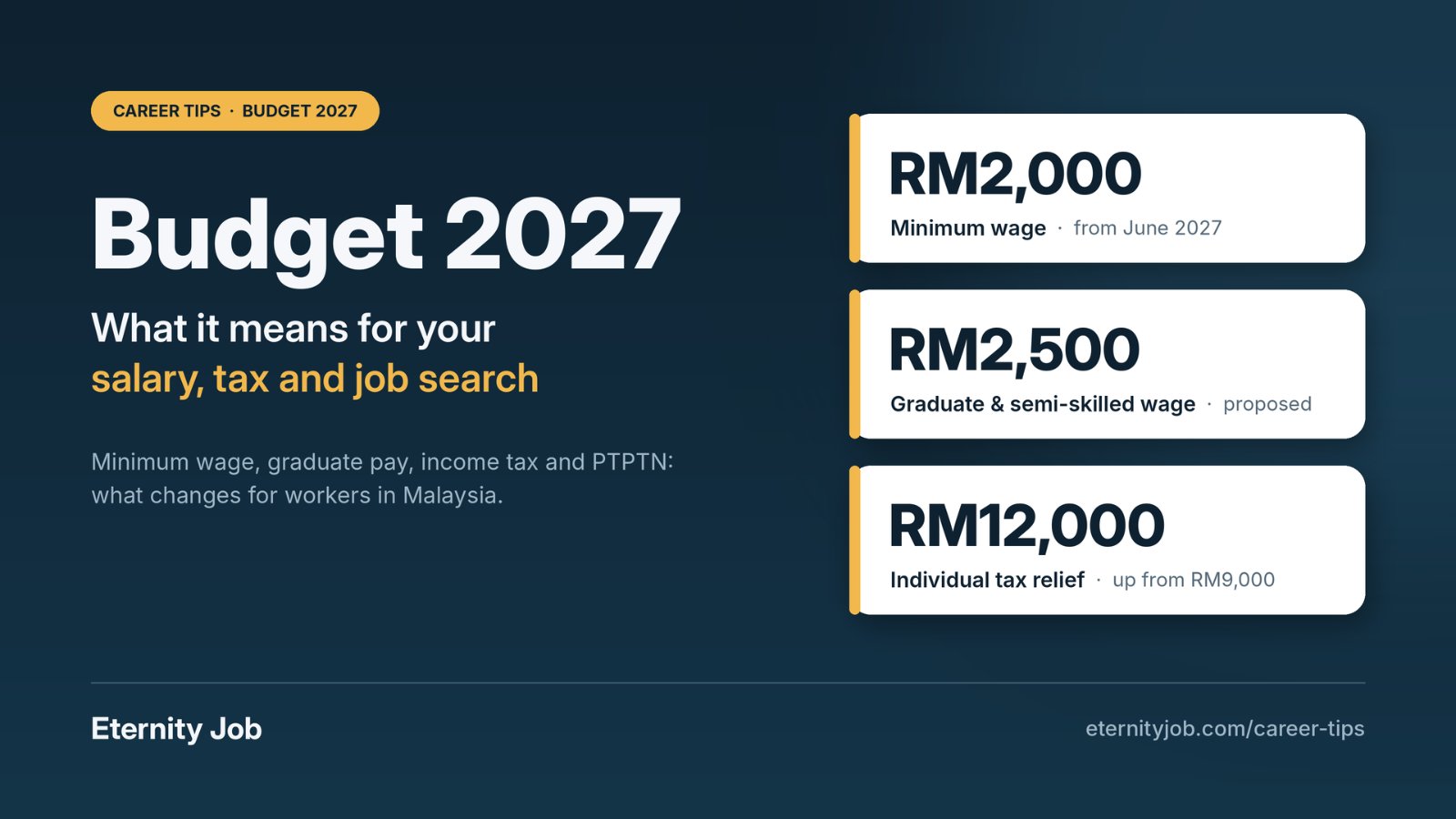
Budget 2027 was tabled on 9 October 2026. For most workers, the headline changes are a higher minimum wage, a new wage floor for graduates, lower income tax and easier PTPTN repayments.
This guide explains what each one means for your pay, your tax and your next job. Most measures still need a law, a gazetted order or a guideline before they apply, so we flag which details are fixed and which are not.
The short version
Minimum wage: RM1,700 to RM2,000 a month from June 2027. MSMEs with annual sales under RM50 million are exempt.
Graduates and semi-skilled workers: a RM2,500 monthly minimum wage, with no start date yet.
Tax relief: individual relief raised from RM9,000 to RM12,000, proposed from year of assessment 2027.
Tax rates: 18% on chargeable income of RM70,001 to RM100,000 and 24% on RM100,001 to RM150,000, proposed from year of assessment 2027.
PTPTN: in 2027, repayments are deferred if you earn up to RM2,500, with a RM50 minimum if you earn RM2,500 to RM3,000.
Training: RM3 billion for 3 million HRD Corp training places in 2027, and RM8 billion for TVET overall.
Gig workers: a RM160 million package co-funded with Grab from 2027, plus SOCSO and EPF matching.
EPF: every citizen registered as a member automatically at 18, with no start date yet.
Minimum wage: RM2,000 from June 2027, but not everywhere
The minimum wage rises from RM1,700 to RM2,000 a month from June 2027. That is RM300 more, or about 17.6%, and the government says it covers more than 4 million workers.
The catch is the exemption. Micro, small and medium enterprises (MSMEs) with annual sales below RM50 million do not have to pay the new rate. The same speech says MSMEs employ about 8 million people, half the workforce.
So whether you get RM2,000 depends on your employer's size, not only your job. The speech does not say how long the exemption lasts. Expect those details in the Minimum Wages Order, which must be gazetted before June.
Two related changes:
Living wage at GLCs. Government-linked companies and investment funds will raise their living wage benchmark from RM3,100 to RM3,400 a month, covering about 230,000 workers.
Cash wages. Companies other than MSMEs can only claim tax deductions on wages paid into a bank account. If a large employer still pays you in cash, expect that to change.
If you are job hunting now: an offer between RM1,700 and RM2,000 from a large company may need to rise in June 2027. Ask HR whether the offer will be revised when the new rate takes effect.The RM2,500 wage for graduates: a direction, not yet a rule
The government says it will reform the workers' income framework, "beginning with" a RM2,500 monthly minimum wage for semi-skilled workers and graduates. This is the announcement fresh graduates are asking about most.
What the speech does not say yet:
when it starts
which jobs count as semi-skilled
which employers must pay it, and whether MSMEs are exempt as with the RM2,000 rate
Until those details are published, treat RM2,500 as a signal of where pay is heading, not an entitlement. Don't turn down a RM2,200 offer assuming the law will soon force it to RM2,500.
You can still use it. RM2,500 is now a government-backed reference point for a graduate starting salary, which helps when you set your range. Our guide on answering "What is your expected salary?" shows how.
Income tax: lower bills for the M40
If you pay income tax, Budget 2027 proposes three changes from year of assessment 2027. The government estimates about 5 million taxpayers will keep up to RM1,600 more a year.
Bigger individual relief. The automatic relief rises from RM9,000 to RM12,000, its first review since 2010.
Lower rates in two bands. Chargeable income of RM70,001 to RM100,000 will be taxed at 18%, and RM100,001 to RM150,000 at 24%. Both are one percentage point lower.
Wider reliefs. The education and skills training relief will cover all fields of study. Lifestyle relief will include AI software subscriptions.
A rough example: if your chargeable income would have been RM85,000, you save about RM690. That is RM150 from the lower rate plus about RM540 from the extra RM3,000 relief.
Income above RM1 million will be taxed at 30%.
These are proposals until the Finance Bill passes. You would claim them when you file for 2027, in 2028. Your monthly tax deduction (PCB) may adjust earlier once LHDN updates its schedules, so check your payslip in early 2027.
Worth doing now: if you plan to take a course or pay for an AI tool in 2027, keep the receipts.
PTPTN: breathing room for your first jobs
For 2027, PTPTN borrowers earning up to RM2,500 a month can defer repayments. Those earning RM2,500 to RM3,000 pay a minimum of only RM50 a month. The government says over 400,000 borrowers benefit.
Borrowers with no arrears who repay regularly get a 10% discount, so keep paying if you can.
There is also a new employer incentive. Companies that repay PTPTN loans on behalf of employees get a tax deduction for payments from 1 January 2027 to 31 December 2028. When you negotiate an offer, it is now reasonable to ask whether the company will contribute to your PTPTN as a benefit.
Training, jobs programmes and AI skills
The budget puts RM8 billion into TVET across ministries in 2027. If you want to upskill or switch careers, these are the parts to watch:
HRD Corp: RM3 billion for 3 million training places, including continuing professional development. If you are employed, ask HR which HRD Corp-claimable courses you can take.
PTPK: RM500 million to finance trainees at public and private institutes registered with PTPK.
Bakat Madani: a target of 30,000 new job opportunities in 2027 through GLICs, PETRONAS, GLCs and now private companies. Companies running its training get a tax deduction.
Free AI tools and courses: another 100,000 free AI subscriptions for young people, and free access to over 16,000 Coursera courses through Rakyat Digital.
AI professionals: MDEC will train and certify 5,000 AI professionals, towards a national target of 200,000 AI-skilled workers.
Sector programmes: CIDB will train 10,000 young people in robotics and digital skills. HRD Corp will train 8,000 people for elderly care jobs. ADTEC runs an advanced automotive programme for graduates.
Contract doctors: more than 9,000 will be offered permanent posts in 2027. Going forward, doctors who complete housemanship will be offered permanent appointments.
Mention any completed programme or certificate on your profile. Employers filtering for skills will see it.
Gig workers
About 600,000 Malaysians drive for e-hailing or p-hailing platforms. A consultative council is negotiating a minimum income rate and minimum social protection for gig work, due to be finalised in early 2027.
Until then:
Higher net income. The government and Grab will share a RM160 million package from 2027. It covers a higher minimum income rate, vehicle maintenance and insurance help, and SOCSO contributions. Median net income is expected to rise by up to RM227 a month for e-hailing drivers and RM100 for delivery riders.
SOCSO matching. The government will match 35% of e-hailing and p-hailing SOCSO contributions, or 50% if the platform also contributes. Self-employed workers in 17 other sectors get a 70% match.
EPF matching. E-hailing and p-hailing drivers can get up to RM600 a year in matched EPF contributions, with a RM6,000 lifetime limit.
If you do gig work alongside job hunting, list it on your profile as experience. It shows initiative and customer handling.
Other changes worth knowing
EPF at 18. Every citizen will be registered as an EPF member automatically on turning 18.
MediAsas. A new affordable medical plan launches in January 2027. EPF members under 55 can pay its premiums from their Sejahtera Account. SMEs with fewer than 75 staff get a RM200 first-year subsidy per employee, for up to 50 employees.
Working spouses of expats. From 1 January 2027, Dependant Pass holders married to Category I Employment Pass holders can work in Malaysia, subject to conditions.
Civil servants. Maternity leave rises to a maximum of 98 days per childbirth, matching private-sector leave under the Employment Act. Civil servants at Grade B and below, including contract staff, also get RM1,500 in special financial assistance.
Regional jobs. Nexus Sedenak in the Johor-Singapore Special Economic Zone has potential for 45,000 jobs. Kulim Hi-Tech Park and the Tanjong Malim automotive hub are also expanding.
Watch for scams. Expect fake messages offering "Budget 2027 aid" or jobs that ask you to pay a fee or share your bank login. Real government aid never asks for payment. See how to spot a fake job offer.What to do now
Ask about June 2027. If you earn under RM2,000 or have an offer below it, ask HR whether the company will move to the new rate.
Set your graduate range with RM2,500 in mind, but negotiate on the offer in front of you, not on a rule that isn't final.
Ask about PTPTN help as part of your package. Employers now get a tax deduction for it.
Book funded training. Check HRD Corp-claimable courses with your employer, or start a free Coursera course through Rakyat Digital.
Keep 2027 receipts for courses, AI subscriptions and other reliefs.
Wait for the details before making big money decisions. The Finance Bill and Minimum Wages Order will fix the exact rules.
We will update this guide when the Minimum Wages Order and the RM2,500 framework are published.
Sources
Speech: The Fifth MADANI Budget 2027, Ministry of Finance, 9 October 2026
Budget 2027 speech (PDF), Ministry of Finance