Sick leave, hospitalisation, maternity and paternity leave: what you're entitled to
Eternity Job Career Team20 October 2026 · 8 min read
A data analyst at a fintech in Damansara Heights told the line manager about a pregnancy in April. In June, during a restructuring, the analyst's name appeared on the list. HR said it had nothing to do with the pregnancy. Under Malaysian law, that is now HR's problem to prove, not the analyst's.
That shift is one of several changes the Employment Act amendments made from 1 January 2023, alongside longer maternity leave, statutory paternity leave and a separate pool of hospitalisation days. All of it applies to every private-sector employee in Peninsular Malaysia and Labuan, regardless of salary. Sabah and Sarawak have their own labour ordinances with their own rules. What follows is the statutory floor as of October 2026, taken from the Employment Act 1955 as amended, and then what better employers typically add.
Sick leave: 14, 18 or 22 days
Section 60F gives you paid sick leave when a doctor certifies it, and the number of days depends on how long you have been with your employer:
Less than two years: 14 days a calendar year
Two years or more but less than five: 18 days
Five years or more: 22 days
The MC has to come from a registered medical practitioner or a medical officer. If your employer has appointed a panel clinic, the Act expects you to go there, unless the illness or the distance makes that unreasonable. An MC from a registered dental surgeon counts too, out of the same allowance.
There is one rule people forget and employers remember. You must inform, or try to inform, your employer within 48 hours of the sick leave starting. Miss it, and section 60F(2) treats you as absent without permission, even with a valid MC. A short WhatsApp to your manager with a photo of the certificate on the morning you go to the clinic settles it.
If you are paid monthly, sick-leave pay simply means your salary isn't cut for those days.
Hospitalisation: 60 days, now on top
If a doctor certifies that you need to be hospitalised, you are entitled to up to 60 days of paid hospitalisation leave in a calendar year. If the doctor says you need admission but you are not admitted for any reason, the Act treats you as hospitalised anyway.
What changed in 2023 is how the two pools interact. Before the amendments, the 60 days included your ordinary sick leave, so a long admission ate your MC days. The amending Act A1651 deleted that proviso, and the Labour Department's summary describes it as a separation of sick leave and hospitalisation leave. A new employee now has 14 outpatient days and 60 hospitalisation days, which is 74 in total.
Sick leave is not paid while you are receiving SOCSO temporary disablement benefit or workmen's compensation for the same period, because that benefit replaces your wages.
Maternity leave: 98 days
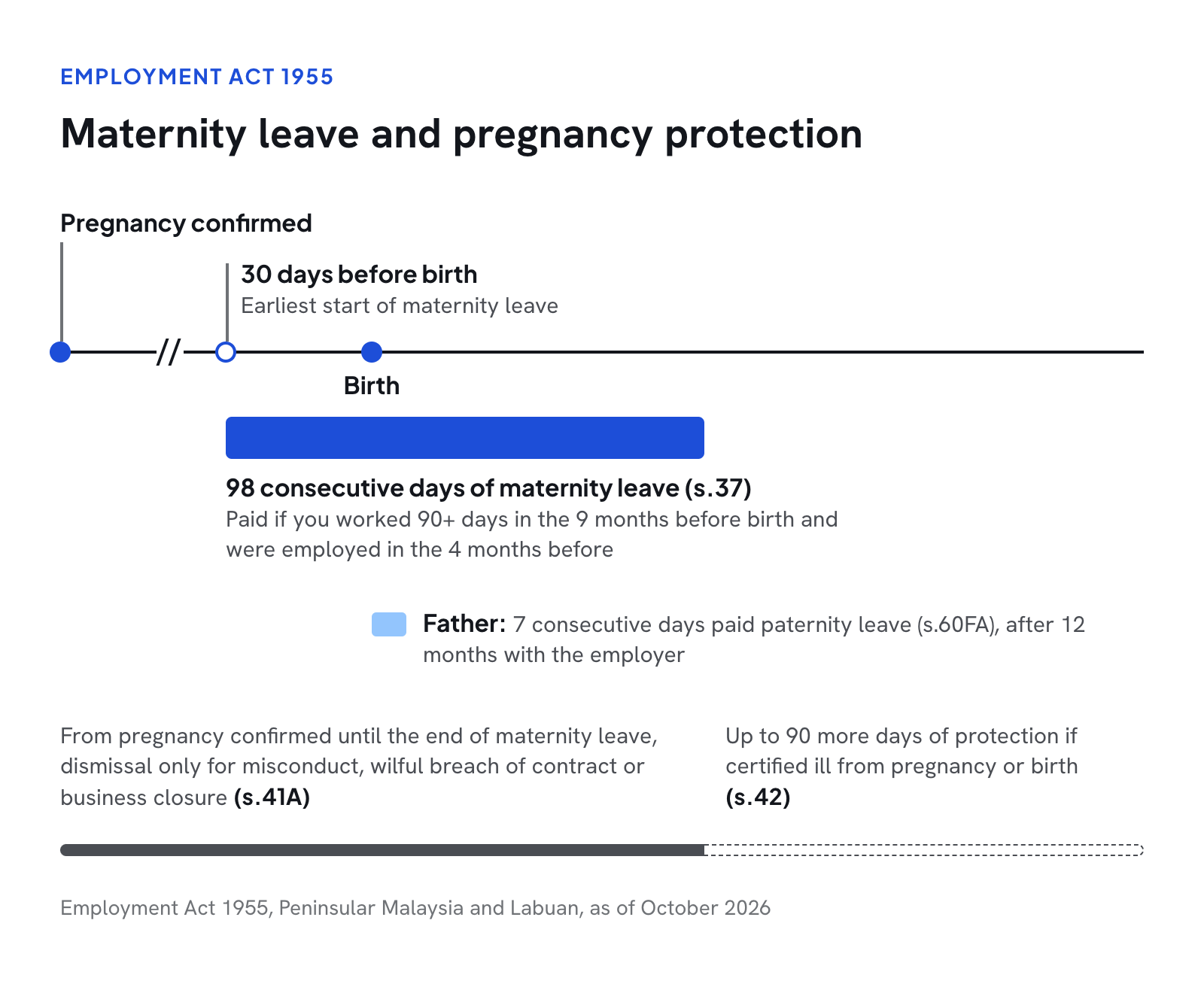
Section 37 entitles every female employee to maternity leave of at least 98 consecutive days for each confinement, up from 60 days before 2023. The leave cannot start earlier than 30 days before the birth, and must start no later than the day after it. If a doctor certifies you are fit, you can return before the 98 days are up, with your employer's agreement.
The leave and the pay are two separate entitlements. You get the leave regardless. To be paid maternity allowance at your ordinary rate for the 98 days, you must meet two conditions in section 37(2):
You have worked for that employer for at least 90 days in total during the nine months before the birth.
You were employed by them at some point in the four months before the birth.
In practice, most women who have been in the job for three months by their due date qualify. If you are changing jobs while pregnant, those two dates are the ones to check before you resign.
There is one exclusion that surprises people. You lose the allowance, but not the leave, if you already have five or more surviving children at the time of the birth. Section 40 adds two notice rules. Within the 60 days before your due date, you must tell your employer the expected date and when you plan to start leave, or your maternity pay can be held back until you do. And if you resign knowing you are likely to give birth within four months, you must tell that employer about the pregnancy before you leave, or you lose the allowance from them. An email to HR covers both.
Protection from dismissal during pregnancy
Back to the analyst in Damansara Heights. Section 41A, added in 2023, makes it an offence for an employer to terminate a pregnant employee, or one with an illness arising from her pregnancy, except for three reasons: wilful breach of contract, misconduct, or closure of the business. Restructuring is not on that list. And if the analyst is dismissed, the burden of proving that the dismissal was not because of the pregnancy rests on the employer.
The protection carries on after the leave. Under section 42, if you are certified unfit to return after your 98 days because of an illness arising from the pregnancy or birth, your employer cannot terminate you for up to 90 more days.
If it happens to you, write down the dates of when you told your employer and when the decision was made, keep every email, and contact the Labour Department through its complaints channels. A dismissal you believe was unfair can also be taken to the Industrial Relations Department, and our guide to constructive dismissal covers what happens when the pressure is to resign instead.
Paternity leave: 7 days
Section 60FA gives a married male employee seven consecutive days of paid paternity leave for each birth, up to five confinements, irrespective of the number of spouses. To qualify, you must:
Have worked for the same employer for at least 12 months immediately before the leave starts
Notify your employer of your spouse's pregnancy at least 30 days before the expected birth, or as soon as possible after it
The 12-month rule is the one that bites. If you change jobs while your wife is pregnant, you will most likely have no statutory paternity leave for that birth. Some employers will give it anyway if you ask during the offer stage, which is the right moment to raise it. See negotiating a job offer for how.
The Act's wording covers married fathers only, and the days must be taken consecutively.
Flexible work when you go back
Since 2023, section 60P lets an employee apply in writing to vary their hours, days or place of work. The employer must answer within 60 days and, if it refuses, give the reason in writing. It is not a right to work from home, but it is a right to a written answer, which is useful when you are negotiating a return after maternity leave.
What good employers add
The Act sets the minimum. Most MNCs and larger Malaysian companies in the Klang Valley go further, and it is worth comparing these when you are choosing between offers:
Medical insurance or a hospitalisation and surgical plan, which pays the bills that leave days don't
Outpatient panel clinics with no cap, or a generous annual cap, often extended to spouses and children
Paternity leave of two to four weeks, sometimes from the first day of employment rather than after 12 months
Maternity leave beyond 98 days, or a phased return on reduced hours at full pay
Paid leave for a child's illness, or a few days of family-care leave
Ask about them before you sign. "Could you share the leave and medical policy?" is a completely normal request at offer stage, and the answer tells you a lot about how the company treats people. Policies at smaller firms tend to stick closer to the statutory minimum, which is lawful but leaves less margin if something goes wrong.
Save the jobs you're considering on Eternity Job, so the ads are easy to find again when the offers arrive and you can line up each company's leave and medical policy against them.
Remember that a contract can always give you more than the Act. It cannot give you less. Section 43 makes any condition that waives your maternity rights void, and a clause offering fewer sick days than section 60F has no effect.