How to answer "What is your expected salary?" on the form and in the interview
Eternity Job Career Team20 October 2026 · 8 min read
A senior marketing executive is applying to an FMCG company in Mid Valley. Halfway down the online application, below education and above notice period, there is a required box: Expected salary (RM). The executive types 6,000, then deletes it, then types 5,500 for fear of being filtered out. Two weeks later, at the second interview, the hiring manager says the budget for the role is up to RM7,000 and asks if RM5,500 is still right.
That is how most people lose money on this question. They answer it once, early, under no pressure, and anchor themselves low. This guide covers the two places you will meet the question, how to work out your number, and what to actually say.
First, work out your number
You can't answer well until you know three figures: the lowest offer you would accept, the figure you would be pleased with, and what the market pays for the role. Do this before you apply.
Your floor is personal. Start from what you earn now, including everything, and add what the move costs you: a longer commute from Klang to Cyberjaya, parking in KLCC, losing a car allowance. Most people moving jobs in the Klang Valley expect a meaningful increase on their current pay, and employers know that. Moving for no increase is a choice you should make deliberately, for a better title or better training, and not by accident.
Market rate is the research part. The pay shown on job ads for similar roles is the most direct evidence you have, because it is what employers are offering this month. Recruitment firms also publish annual salary guides for Malaysia; the Robert Walters Salary Survey and the Michael Page Malaysia Salary Guide are the best known. They are useful for seeing how pay steps up between levels, and they lean towards MNC and larger-company roles, so an SME may pay below them. Friends in the same field, if they will tell you, are worth more than either.
Eternity Job shows the salary on each job card, so you can compare ten ads for the same role in a few minutes. Do that before you fill in the box.
Count the whole package
Malaysian offers are rarely just a basic salary, and two offers with the same basic can be worth very different amounts. Before you compare anything, list what you get now and what you would get in the new role:
Basic salary
Fixed allowances: transport, phone, parking, meal, shift
Bonus: contractual (often called a 13th month) or discretionary, and how many months it has actually paid in recent years
Employer EPF contribution
Medical and dental cover, including dependants
Annual leave days, and any flexible or hybrid working
Commission or incentive schemes, if the role has them
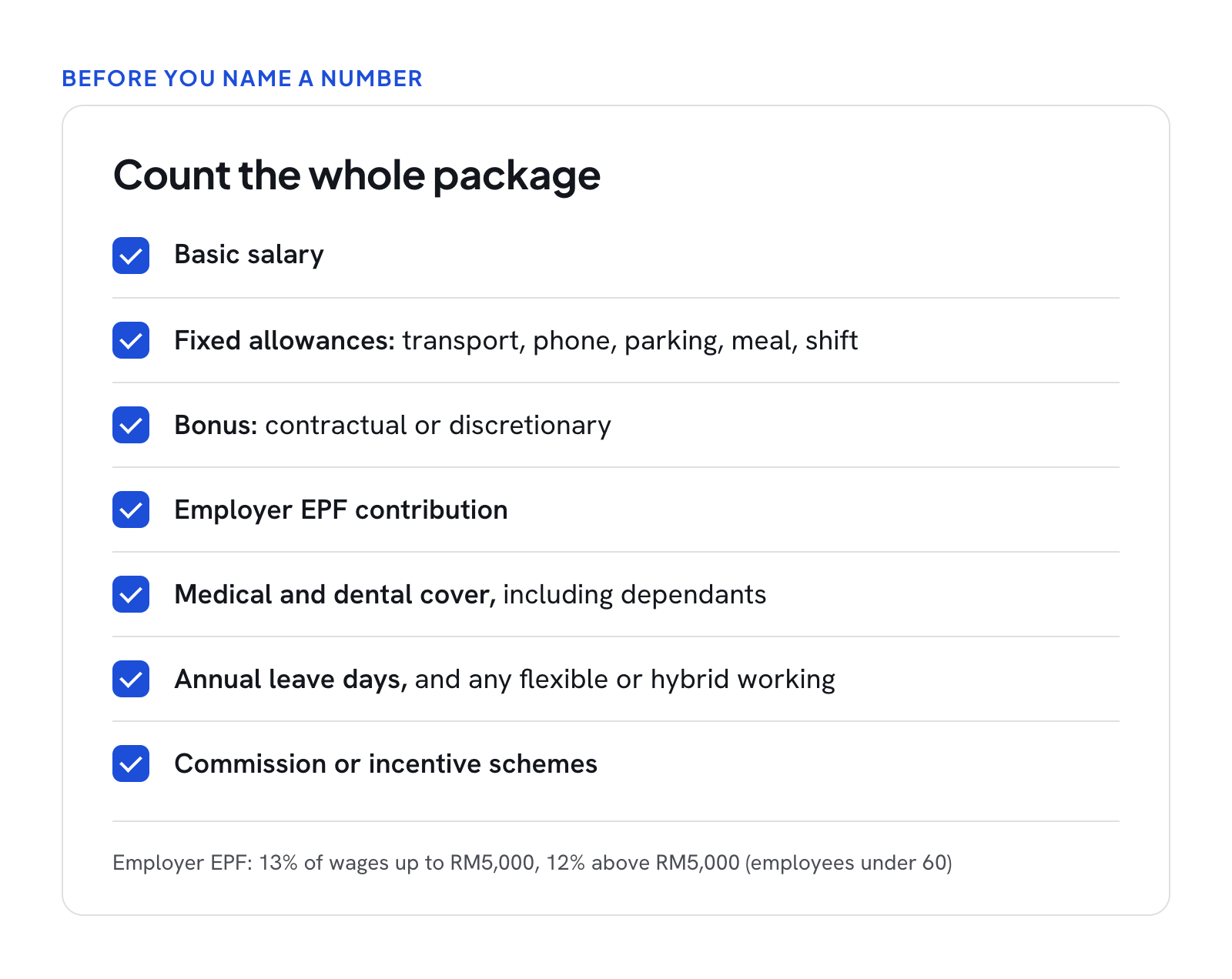
The employer's EPF contribution is the one people forget. For employees under 60, the employer contributes 13% of monthly wages up to RM5,000, and 12% once wages go above RM5,000, on top of your salary (MIDA, citing the EPF Act 1991). Some employers pay above the statutory rate, which is real money that goes into your retirement savings. Ask what rate they contribute.
Whether an allowance counts as "wages" for EPF depends on the allowance, so check your payslip rather than assuming. Our guide on how to read your payslip walks through which lines are which.
Bonuses need more scrutiny than anything else. "Up to three months' bonus" in an interview can mean three months every year, or three months once in 2019. If the bonus is discretionary, ask how much it has paid out for the last two or three years. If you are leaving a job with a contractual bonus for one with a discretionary one, price the difference into your expected basic. Annual bonus and increment covers how these usually work.
On the application form
The form is the worst place to negotiate, and you usually can't leave the box blank. You also don't know yet how senior the role really is, what the budget is, or what the package includes.
Use this order of preference:
If the ad shows a salary range and it's acceptable, enter a figure inside it, at or near the upper end if your experience matches what they're asking for.
If the form accepts a range, enter a range whose bottom is a number you would genuinely be happy with.
If there's a free-text field, write "Negotiable, based on the full package" and add a range if you're comfortable.
If it demands a single number and there's no range on the ad, enter your target figure, the one you would be pleased with. Don't enter your floor.
The marketing executive's mistake was option 4 done backwards. The figure typed was the floor, and the employer took it at face value.
Some forms ask for current salary as well. You can enter it honestly; it is common in Malaysia and lying about it is a bad idea, because some employers ask for your latest payslip or EA form before they issue an offer. What you don't have to do is let your current salary set your expected salary. They are two different questions.
In the interview
When the question comes up in person, you have more room. A good rule: the later in the process you name a number, the better informed that number is. You are trying to delay until you understand the role, and to make sure that when you do answer, you answer with a range anchored by research.
If it comes up in the first interview, before you know much about the job, you can deflect once, politely. If they ask a second time, answer. Deflecting twice starts to look evasive, and some HR teams in Malaysia need the figure to move you to the next round.
Script: deflecting the first time
I'd like to understand the role a bit better first, especially the
scope and what the full package looks like. Could you tell me the
budgeted range for the position? I'm confident we can find a figure
that works if the role is the right fit.
Most recruiters will either give you the range or say they can't. Either way you have learnt something. If they give you a range and it works, you can say so and move on.
Script: giving a range
Based on what I've seen for similar roles in KL and my five years
in performance marketing, I'm looking at between RM6,500 and
RM7,500 a month in basic. That depends on the rest of the package,
particularly the bonus structure and medical cover.
Make the bottom of your range a number you would accept without disappointment. Interviewers hear the bottom figure. A range of RM5,000 to RM8,000 is too wide to be credible; keep it within about 15% from top to bottom.
Script: when they ask for one number
If I had to give one figure, RM7,000. I'm flexible if the bonus or
allowances are strong, so I'd want to look at the offer as a whole.
Script: when they say your number is above budget
I understand. Is there flexibility elsewhere in the package, for
example a fixed allowance, a review at the end of probation, or a
higher EPF contribution? I'm keen on the role, and I'd like to see
if we can close the gap.
A salary review at confirmation is a common way to bridge a small gap, especially at SMEs. If you accept that, ask for it in the offer letter with a date and, ideally, a figure. A verbal promise of "we'll look at it after probation" is easy to forget.
Script: when you're asked about current salary
I'm currently on RM5,800 basic plus a RM400 transport allowance,
with a contractual two-month bonus. For this role I'm looking at
RM6,500 to RM7,500, because the scope is larger and I'd be
managing two people.
Give the current figure honestly, then move straight to the expected figure and the reason for the difference. The reason is what the interviewer will remember.
Things that weaken your answer
Saying "anything is fine" or "up to the company" sounds humble and costs you. Employers make offers on what you tell them. Telling them nothing leaves them to use their own floor.
Justifying your number with personal costs also weakens it. "I have a car loan" tells the interviewer nothing about the job. Justify it with the market and the role: years of experience, scope, what similar ads pay.
And don't name a number you haven't thought about because the question caught you off guard. It is perfectly acceptable to say, "Can I come back to you on that by tomorrow? I want to give you an accurate figure." Then do.
After the number
The expected-salary answer opens the negotiation; the offer letter is where it actually happens. When the offer arrives, read every line before you reply, compare it against the package list above, and respond to the whole thing at once rather than one item at a time. Our guide on how to negotiate a job offer picks up from there.