How to read your payslip: EPF, SOCSO, EIS and PCB line by line
Eternity Job Career Team20 October 2026 · 8 min read
A marketing executive who joined a regional insurer in Bangsar on RM5,500 a month saw a first salary credit of RM4,666. The new hire spent a good ten minutes sure that payroll had made a mistake before opening the payslip and adding it up. Payroll had not made a mistake. About RM834 had gone, quite correctly, to four places.
Most people never read past the net figure, which is a shame, because the payslip is the one document that shows whether your employer is paying into your retirement fund, your social security cover and your tax account the way the law says it must. This guide walks through that executive's payslip line by line. The rates are as of October 2026 and apply to Malaysian citizens and permanent residents working in Peninsular Malaysia. Sabah and Sarawak have their own labour ordinances, though EPF, SOCSO and tax work the same way nationwide.
The payslip, line by line
Here is a simplified version of what the executive received. Your company's layout will differ, but the lines should all be there.
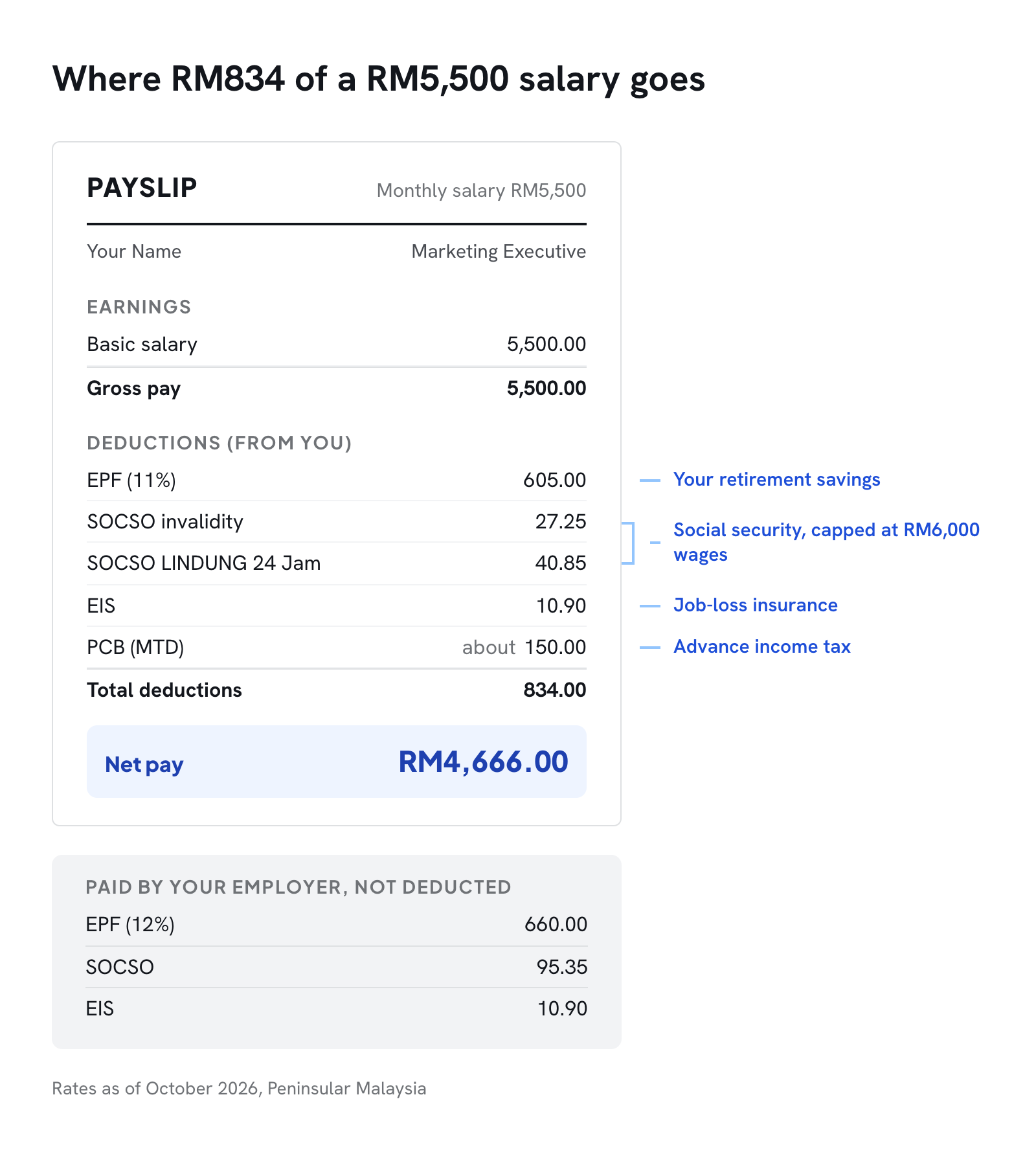
EARNINGS
Basic salary                        5,500.00
Gross pay                           5,500.00

DEDUCTIONS (from you)
EPF (11%)                             605.00
SOCSO - invalidity                     27.25
SOCSO - LINDUNG 24 Jam                 40.85
EIS                                    10.90
PCB / MTD                     about   150.00
Total deductions                      834.00

NET PAY                             4,666.00

EMPLOYER CONTRIBUTIONS (paid on top, not deducted)
EPF (12%)                             660.00
SOCSO                                  95.35
EIS                                    10.90
The deductions add up to roughly 15% of gross pay. At this salary that is a fair rule of thumb when you compare offers.
EPF: 11% from you, 12% or 13% from your employer
The biggest deduction is your EPF (KWSP) contribution. Under the Third Schedule of the EPF Act, an employee under 60 contributes 11% of monthly wages. The employer adds 13% if your wages are RM5,000 or less, and 12% if they are above RM5,000. KWSP sets these out on its employer contribution page.
At RM5,500, the employer pays 12%, which is RM660. Had the offer been RM5,000, the employer would have paid 13%, or RM650. A RM500 raise across that line gives the employer only RM10 more to pay into EPF. It is worth knowing when you negotiate, because the two figures look further apart than they really are.
Strictly, payroll uses KWSP's wage-band table instead of multiplying by the percentage, and the table rounds up to the next ringgit. At a round figure like RM5,500 the two methods agree. KWSP says the exact percentage is only used for salaries above RM20,000.
A few other things to know:
If you are 60 or older, your share drops to 0% and your employer pays a minimum of 4%. KWSP confirmed this on its site when the rate took effect in 2019.
Non-Malaysian employees became liable for mandatory EPF from October 2025 wages, at 2% from the employee and 2% from the employer, according to KWSP's announcement.
EPF is charged on more than basic pay. KWSP's member page lists bonuses, commissions and most allowances as liable. Overtime pay, gratuity and payment in lieu of notice are not.
Every new contribution is split 75% into Akaun Persaraan, 15% into Akaun Sejahtera and 10% into Akaun Fleksibel, a split in place since May 2024.
SOCSO: why the deduction went up in June 2026
If you compare a payslip from May 2026 with one from July, the SOCSO line will have grown. That is not a payroll error either.
SOCSO (PERKESO) contributions are worked out on wages up to a ceiling of RM6,000 a month, raised from RM5,000 on 1 October 2024, according to PERKESO's rate page. Earn RM9,000 and you still pay SOCSO as if you earned RM6,000.
Until June 2026 the employee paid only the invalidity scheme, at about 0.5% of wages. On 1 June 2026 PERKESO started the LINDUNG 24 Jam scheme, which covers accidents that happen outside work, at home, on a balik kampung drive or on the futsal court. The employee pays all of it. PERKESO's FAQ sets the rate at 0.75% of wages until 31 May 2028, then 1.00% until 31 May 2031, then 1.25%, though it says the later phases are still subject to confirmation.
So in the first phase, the split under the employees' first category is:
Employer: 1.25% employment injury plus 0.5% invalidity, 1.75% in total
Employee: 0.5% invalidity plus 0.75% LINDUNG 24 Jam, 1.25% in total
Like EPF, SOCSO is charged by wage band. For wages above RM5,400 and up to RM5,500, PERKESO's combined rate table gives the executive's share as RM27.25 plus RM40.85, and the employer's as RM95.35. At the RM6,000 ceiling the employee pays RM74.40 a month.
Some payroll systems print the two employee amounts on one SOCSO line. Either is fine, so long as the total matches the band.
EIS: the smallest line
The Employment Insurance System, also run by PERKESO, pays you a share of your wages and helps you find work if you lose your job through retrenchment or closure. Employer and employee each pay about 0.2% of wages, again on the RM6,000 ceiling. On PERKESO's Act 800 table the RM5,500 band is RM10.90 each, and the most anyone pays is RM11.90.
PCB: tax paid in advance, not your final bill
PCB (potongan cukai bulanan), also called MTD, is income tax your employer takes each month and sends to LHDN. It is an estimate of your annual tax, spread across twelve payslips. It is not the final word.
LHDN's formula is detailed, but you can get close with the annual rates. For the executive, assuming a single filer who claims nothing beyond the automatic reliefs:
Annual salary             5,500 x 12 = 66,000.00
Less individual relief                 9,000.00
Less EPF relief (capped)               4,000.00
Less SOCSO + EIS relief (capped)         350.00
Chargeable income                     52,650.00

Tax on the first 50,000                1,500.00
Tax on the next 2,650 at 11%             291.50
Annual tax                             1,791.50
Monthly, divided by 12          about    149.30
The individual relief of RM9,000, the RM4,000 cap on EPF relief and the RM350 cap on SOCSO and EIS relief all come from LHDN's relief list, and the bands come from its tax rate table. Payroll's own figure can land a few ringgit either side depending on how the reliefs are fed in, which is why the example payslip shows about RM150.
Two things follow from this. If you pay for life insurance, a laptop, gym membership or your parents' medical bills, you can declare those reliefs to payroll on the TP1 form and your PCB drops now, not after you file. And if PCB was your only tax and it was deducted all year, LHDN treats it as your final tax and you may choose not to file a return. Most people with any extra income or reliefs should still file, because that is where a refund comes from.
Budget 2027, tabled on 9 October 2026, proposes raising the individual relief to RM12,000 and cutting the rate on the RM70,001 to RM100,000 band from 19% to 18%, from year of assessment 2027, according to EY's Budget 2027 summary. These still have to pass Parliament. If they do, the executive's extra RM3,000 of relief at 11% would save about RM330 a year, or roughly RM27 a month off PCB.
What your employer pays that you never see
The employer contributions at the bottom of the payslip are not taken from you, but they are part of what you cost. The insurer spends RM5,500 plus RM660 in EPF, RM95.35 in SOCSO and RM10.90 in EIS, a total of RM6,266.25 a month before medical cover, HRD Corp levy or anything else.
That is useful context in a negotiation. When a hiring manager says the budget for a role is "RM6,300", ask whether that is the salary or the cost to company. The answer changes your take-home by around RM700 a month.
Every job on Eternity Job shows its salary range on the card, and that figure is gross. At around RM5,500, take off about 15% for a quick sense of what lands in your account.
Checks worth doing every month
Payslips are rarely wrong, but when they are, the error tends to compound quietly for months. These take five minutes:
Confirm your EPF contributions arrived. Employers must pay by the 15th of the following month, and the KWSP app shows each credit.
Check the SOCSO and EIS bands against your gross. If your pay went up and the deductions didn't, the system may be using an old salary.
If you are under 60, your own EPF share should be 11% at any salary. Your employer's should be 13% up to RM5,000 and 12% above it. Anything lower is worth a question.
Keep your Borang EA. Your employer must give you this annual statement of earnings and deductions by the end of February, and you will need it to file.
If something is missing and HR can't explain it, unpaid EPF can be reported to KWSP and unpaid SOCSO to PERKESO. For overtime lines that look short, our guide to calculating overtime pay has the formula. And if you are weighing two offers with different structures, negotiating a job offer covers how to compare them on more than the headline figure.