"Tell me about yourself": a structure that works, with three example answers
Eternity Job Career Team20 October 2026 · 5 min read
Almost every interview in Malaysia opens with the same line. The hiring manager glances at your CV, puts it down and says, "So, tell me about yourself." Most candidates treat it as small talk and answer by reciting their CV from secondary school onwards. Four minutes later the interviewer has learnt nothing they couldn't read on paper, and you have used up the part of the interview where they are paying the closest attention.
This question is a pitch. The interviewer wants to know who you are at work, whether you can explain yourself clearly, and why you are sitting in that room in particular. Answer those three things in about 90 seconds and the rest of the interview gets easier, because you have told them which parts of your CV to ask about.
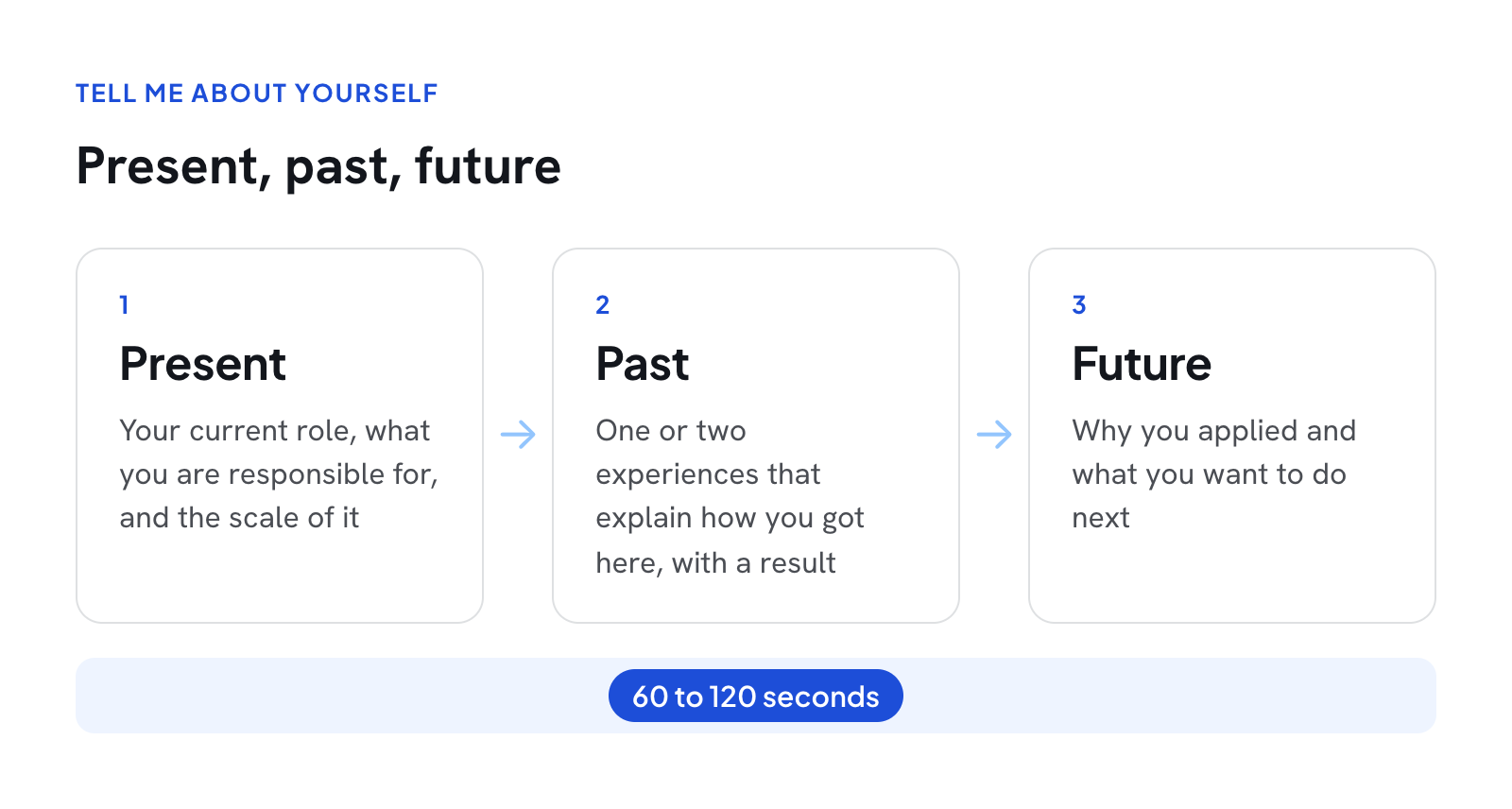
The structure: present, past, future
Start with where you are now, go back to what got you here, then explain why this job is the next step. It works because it puts your most relevant information first, and it ends on the employer, which is where you want the conversation to go next.
Present. Your current role, what you are responsible for, and the scale of it. One or two sentences. If you are a fresh graduate, your present is your degree and whatever you did alongside it.
Past. One or two experiences that explain how you got here, ideally with a result attached. Choose them for this job. A procurement manager interviewing for a supply chain role should lead with the vendor consolidation project, even if the thing they are proudest of is the ERP rollout.
Future. Why you applied and what you want to do next. This is the part most people skip, and it is the part that tells the interviewer you have read the job ad. Make it specific to the role and, where you can, to the company.
Keep the whole thing between 60 and 120 seconds. Shorter sounds rehearsed and thin; longer and the interviewer starts writing notes about something else.
What to leave out
Your hometown, your secondary school, your hobbies and your full employment history in date order can all wait. Klang Valley interviewers often ask about family or hometown later to build rapport, and you can answer warmly then.
Leave out anything negative about your current employer, too. If you are leaving because of a bad manager or a restructuring, the "future" section can say what you are moving towards. Nobody needs to hear about the retrenchment exercise in the first two minutes.
If there is a gap in your CV, don't open with it, and don't hide from it either. Mention it in a single neutral sentence in the "past" section if it falls in the period you are describing, and save the full explanation for when they ask. Our guide on explaining a gap in your resume has wording for the common cases.
How to prepare yours
Write it out in full first, then cut it. Most first drafts run to 300 or 400 words. Get it down to around 200, which is roughly 90 seconds spoken at a normal pace.
Then stop treating it as a script. Reduce it to a few prompts you can glance at:
Present: current role, scope, one number
Past: the one or two experiences that explain this application
Future: why this role, why this company, one detail from the ad
Say it out loud, several times, on different days. Record yourself on your phone if you can bear to listen back. You are listening for filler ("basically", "actually", "so yeah") and for places where you run out of breath, which usually means a sentence is too long.
The "future" section should change for every application. If you find yourself giving the same closing lines to a bank and a logistics company, you haven't done the research yet.
When they ask it differently
"Introduce yourself" and, in a Malay-medium interview, "Boleh perkenalkan diri?" take the same answer. "Walk me through your CV" invites a chronological one, but you can still lead with the present in one sentence ("I'm currently X"), then go back to the start and move forward briskly, giving the most time to the most relevant roles.
If you are interviewed by a panel, look at the person who asked, then include the others as you go. If the interviewer cuts in with a question halfway through, answer it. Don't try to steer back to your prepared version; the interruption tells you what they care about.
Aim to sound like someone describing their own work to a colleague. When you finish, hand the conversation back: "That's the short version. Happy to go into any of it." Then stop talking and let them choose. At the end of the interview you will get your turn to ask; our list of questions to ask the interviewer will help you use it well.