Following up after an interview, with email templates you can copy
Eternity Job Career Team20 October 2026 · 8 min read
Send a short thank-you email on the day of your interview. Most candidates in Malaysia don't, which is exactly why it's worth doing: it costs you ten minutes and puts your name in front of the hiring manager one more time, while they are still comparing candidates.
What comes after that is harder. Companies here are often slow to reply, and some never do. Knowing when to chase, how often, and when to stop will save you a lot of refreshing your inbox. So will knowing how to answer a rejection in a way that keeps the door open.
Before you leave the interview
Good follow-up starts in the interview room. Before you go, ask two things: what the next step is, and roughly when you should hear back. Then get the name and email address of the person you should write to. If the interview was arranged by HR, that's usually the HR executive. If the hiring manager gave you a card, you can write to them as well.
Write the timeline down. "We're finishing interviews this week and will decide by end of next week" is the most useful sentence you'll hear all day, because it tells you exactly when a follow-up is reasonable.
The thank-you email
Send it the same day, or the next morning at the latest. Keep it short: four or five sentences. Its job is to thank them, remind them who you are, and add one specific thing that strengthens your case.
That specific thing matters. "Thank you for your time, I look forward to hearing from you" is polite and forgettable. Refer to something you actually discussed. If there was a question you answered badly, you can add a sentence that answers it better, but only one; this isn't a second interview.
Here is how a candidate interviewed for a business analyst role at a regional bank's office in KL Sentral might write one:
Subject: Thank you – Business Analyst interview, 14 October

Dear [Interviewer's name],

Thank you for taking the time to meet me today about the Business
Analyst role. I enjoyed hearing about the plans to move the loan
approval workflow onto the new platform next year.

You asked whether I'd worked with process mapping tools at scale.
I should have mentioned that in my current role I mapped the full
customer onboarding process, about 40 steps across four
departments, which became the basis for our system requirements.

I'm very interested in the role and would be glad to provide
anything else you need.

Best regards,
[Your name]
012-345 6789
If you met a panel, one email to the main contact is fine; you can ask them to pass your thanks on. Separate emails to each panel member are acceptable if you have their addresses, as long as each one is slightly different. They will compare notes.
Use email, not WhatsApp, unless the interviewer contacted you on WhatsApp themselves and has been using it for scheduling. Even then, a thank-you reads better as an email, because it can be forwarded to whoever makes the decision.
When you hear nothing
This is the most common situation, and the one people handle worst. They either never follow up, or they follow up every two days.
Wait until the date they gave you has passed, then give it another two or three working days. Hiring decisions in Malaysia slip all the time: a director is travelling, a budget needs regional sign-off, the preferred candidate is still deciding. A slipped date is rarely a signal about you.
If they didn't give you a date, wait about a week from the interview.
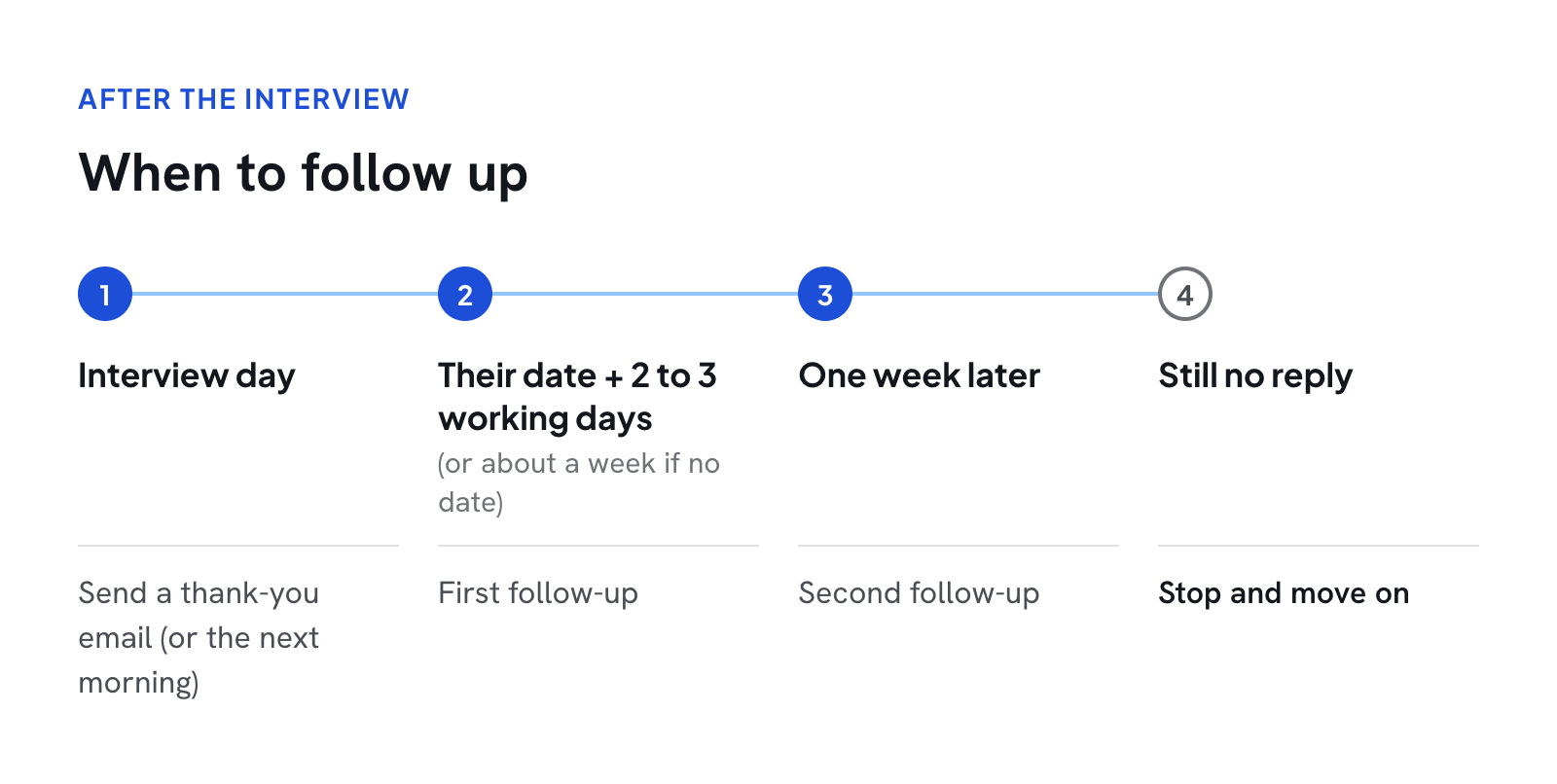
Your first chase should be brief, friendly and easy to answer.
Subject: Following up – Business Analyst interview

Dear [HR contact's name],

I hope you're well. I interviewed for the Business Analyst role on
14 October and wanted to check whether there's an update on the
next stage.

I remain very interested in the position. Please let me know if
you need anything further from me.

Best regards,
[Your name]
If there's still no reply after another week, send one more. Shorten it further, and if you have a real reason to need an answer, such as another offer, say so plainly.
Subject: Business Analyst role – checking in

Dear [HR contact's name],

I wanted to follow up once more on the Business Analyst role. I've
received another offer and need to respond by 31 October. This role
is still my first choice, so I'd be grateful for any update on the
timeline before then.

Best regards,
[Your name]
Only mention another offer if you have one. Inventing a deadline to hurry an employer up is easily found out and will cost you the job if they ask to see it.
After two follow-ups with no reply, stop. You can assume the answer is no, or that the role has been frozen, and put your energy into other applications. If they come back to you a month later, and some do, you can decide then if you still want it.
If you applied through Eternity Job, you can message the employer about your application from the application page, and you'll see when its status changes. That is often quicker than email.
Responding to a rejection
Reply to a rejection. Almost nobody does, and the few who do are remembered. Companies reopen roles when the chosen candidate fails probation or declines at the last minute, and hiring managers move to other companies and take their shortlists with them. A gracious two-line reply costs nothing and occasionally pays off months later.
Don't argue with the decision or ask them to reconsider. You can ask for feedback, but make it easy to say no, because many companies have a policy against giving it and HR may not be allowed to.
Subject: Re: Business Analyst role

Dear [HR contact's name],

Thank you for letting me know, and for the time you and
[Interviewer's name] gave me during the process. I'm disappointed, but I enjoyed learning
about the team.

If you're able to share any feedback on my interview, I'd find it
very useful. I understand if that isn't possible.

I'd be glad to be considered for future roles that fit my
background.

Best regards,
[Your name]
If they do send feedback, thank them for it, even if you disagree. Feedback is uncomfortable to give, and arguing with it guarantees you'll never get any again. Write down what they said; patterns across several rejections tell you more than any single one.
If you got as far as a final round and felt you built a real rapport with the hiring manager, you can also connect with them on LinkedIn a week or so later with a short note. Keep it light. Don't use it to restart the conversation about the job.
When the answer is yes
Sometimes the follow-up you need to write is the happy one. When an offer arrives, acknowledge it within a day, even if you need longer to decide.
Subject: Re: Offer of employment – Business Analyst

Dear [HR contact's name],

Thank you very much for the offer. I'm delighted. Could I take until
Friday, 24 October, to review the details and come back to you?

In the meantime, could you confirm the bonus structure and the
start date you have in mind?

Best regards,
[Your name]
Asking for two or three working days is normal and won't put the offer at risk. Use them. Read the letter properly, check the full package, and work out your notice period before you agree to a start date; our guide on your notice period covers how to calculate it. If anything in the offer needs to change, our guide on how to negotiate a job offer has the next set of scripts.
A few small things that matter
Check the spelling of the interviewer's name, including whether they go by an English name, a Chinese name, or both. A title and surname lands differently from a given name, and you should match how they introduced themselves.
Send from a professional email address. If yours is still the one you made in Form 3, set up a new one with your name.
Keep the subject line specific: the role and the date. HR executives at large employers may be handling dozens of candidates across several roles, and "Follow up" on its own gets lost.
And reply from the same thread wherever you can, so the whole history sits in one place for whoever picks it up.