Public holidays 2027 in Malaysia: federal and state list, and your rights at work
Eternity Job Career Team20 October 2026 · 9 min read
The dates below come from the 2027 schedule published by the Cabinet Division of the Prime Minister's Department, as of October 2026. The department marks some dates "subject to change", and we've flagged those. We'll update this page if any date moves.
Malaysia has fifteen federal public holiday dates in 2027, one of them observed in only four states, and you are not legally owed all of them. Three fall on a Saturday and three on a Sunday, so a Klang Valley office worker on a five-day week will feel the calendar shrink, starting with Chinese New Year in February.
The source for every date is the official Jadual Hari Kelepasan Am 2027. The employment rules come from section 60D of the Employment Act 1955, which covers Peninsular Malaysia and Labuan. Sabah and Sarawak have their own Labour Ordinances, so the holiday-pay rules for staff there differ in detail even where the dates are the same.
Federal holidays by month
These apply in every state and federal territory unless noted. Dates marked provisional are the ones the Prime Minister's Department lists as subject to change.
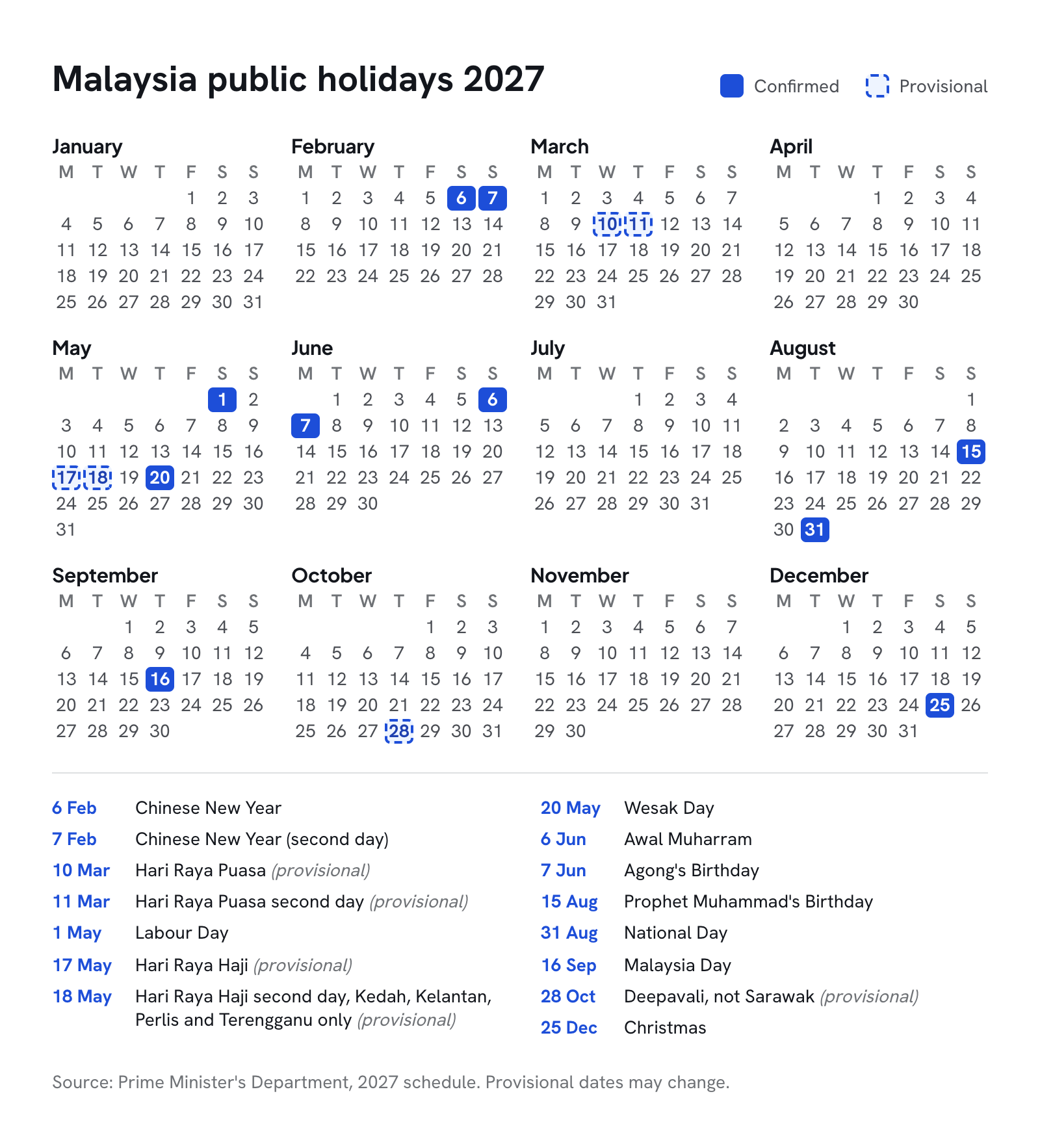
February
Saturday 6 February: Chinese New Year
Sunday 7 February: Chinese New Year, second day. Kelantan and Terengganu gazette this as a state holiday, so it's observed nationwide.
March
Wednesday 10 March: Hari Raya Puasa
Thursday 11 March: Hari Raya Puasa, second day
May
Saturday 1 May: Labour Day (Hari Pekerja)
Monday 17 May: Hari Raya Haji (Hari Raya Qurban)
Tuesday 18 May: Hari Raya Haji, second day, in Kedah, Kelantan, Perlis and Terengganu only
Thursday 20 May: Wesak Day
June
Sunday 6 June: Awal Muharram (Maal Hijrah)
Monday 7 June: Official Birthday of the Yang di-Pertuan Agong
August
Sunday 15 August: Prophet Muhammad's Birthday (Maulidur Rasul)
Tuesday 31 August: National Day (Hari Kebangsaan)
September
Thursday 16 September: Malaysia Day
October
Thursday 28 October: Deepavali, every state except Sarawak
December
Saturday 25 December: Christmas Day
State holidays
These are on top of the federal list. The Klang Valley comes first because that's where most of our readers work. Israk and Mikraj appears twice in 2027 because the Islamic year runs about eleven days shorter than the Gregorian one.
Kuala Lumpur and Putrajaya
Friday 1 January: New Year's Day
Friday 22 January: Thaipusam
Monday 1 February: Federal Territory Day
Wednesday 24 February: Nuzul Al-Quran
Selangor
Friday 1 January: New Year's Day
Friday 22 January: Thaipusam
Wednesday 24 February: Nuzul Al-Quran
Saturday 11 December: Birthday of the Sultan of Selangor
Labuan
Friday 1 January: New Year's Day
Monday 1 February: Federal Territory Day
Wednesday 24 February: Nuzul Al-Quran
Sunday 30 and Monday 31 May: Pesta Kaamatan
Johor
Friday 22 January: Thaipusam
Monday 8 February: Awal Ramadan
Tuesday 23 March: Birthday of the Sultan of Johor
Sunday 11 July: Hari Hol Almarhum Sultan Iskandar
Kedah
Wednesday 6 January: Israk and Mikraj
Monday 8 February: Awal Ramadan
Sunday 20 June: Birthday of the Sultan of Kedah
Sunday 26 December: Israk and Mikraj
Kelantan
Wednesday 24 February: Nuzul Al-Quran
Sunday 16 May: Hari Arafah
Wednesday 29 and Thursday 30 September: Birthday of the Sultan of Kelantan
Melaka
Friday 1 January: New Year's Day
Saturday 20 February: Declaration of Independence Day
Friday 12 March: Hari Raya Puasa, third day
Tuesday 24 August: Birthday of the Yang di-Pertua Negeri of Melaka
Negeri Sembilan
Friday 1 January: New Year's Day
Wednesday 6 January: Israk and Mikraj
Thursday 14 January: Birthday of the Yang di-Pertuan Besar of Negeri Sembilan
Friday 22 January: Thaipusam
Sunday 26 December: Israk and Mikraj
Pahang
Friday 1 January: New Year's Day
Wednesday 24 February: Nuzul Al-Quran
Saturday 22 May: Hari Hol Almarhum Sultan Ahmad Shah
Friday 30 July: Birthday of the Sultan of Pahang
Penang
Friday 1 January: New Year's Day
Friday 22 January: Thaipusam
Wednesday 24 February: Nuzul Al-Quran
Wednesday 7 July: Anniversary of George Town's World Heritage Site listing
Saturday 10 July: Birthday of the Yang di-Pertua Negeri of Penang
Perak
Friday 1 January: New Year's Day
Friday 22 January: Thaipusam
Wednesday 24 February: Nuzul Al-Quran
Friday 5 November: Birthday of the Sultan of Perak
Perlis
Wednesday 6 January: Israk and Mikraj
Wednesday 24 February: Nuzul Al-Quran
Monday 17 May: Birthday of the Raja of Perlis
Sunday 26 December: Israk and Mikraj
Terengganu
Wednesday 6 January: Israk and Mikraj
Wednesday 24 February: Nuzul Al-Quran
Thursday 4 March: Anniversary of the Installation of the Sultan of Terengganu
Monday 26 April: Birthday of the Sultan of Terengganu
Sunday 16 May: Hari Arafah
Sunday 26 December: Israk and Mikraj
Sabah
Friday 1 January: New Year's Day
Friday 26 March: Good Friday
Tuesday 30 March: Birthday of the Yang di-Pertua Negeri of Sabah
Sunday 30 and Monday 31 May: Pesta Kaamatan
Friday 24 December: Christmas Eve
Sarawak
Friday 1 January: New Year's Day
Friday 26 March: Good Friday
Tuesday 1 and Wednesday 2 June: Gawai Dayak
Thursday 22 July: Sarawak Independence Day
Saturday 9 October: Birthday of the Yang di-Pertua Negeri of Sarawak
Replacement days for public servants, the cuti ganti that ministries announce when a holiday falls on a weekend, are not in the schedule. Those announcements govern government offices and schools. In the private sector, your replacement day comes from the Employment Act and your contract.
How many of these you're actually owed
Section 60D(1) gives you eleven paid public holidays a year, chosen from the gazetted list. Five are fixed by law: National Day, the Agong's Birthday, the Ruler's birthday in the state where you mainly work (or Federal Territory Day if you work in a federal territory), Labour Day and Malaysia Day. Your employer picks the other six and must put up a notice at the workplace listing them before the year begins. By agreement, you and your employer can swap one of those six for another day.
For a Klang Valley office, that means a KL-based employee's five compulsory holidays are 1 February, 1 May, 7 June, 31 August and 16 September. Move across the border to a Shah Alam office and Federal Territory Day drops out, replaced by the Sultan of Selangor's birthday on 11 December.
Many employers give more than eleven, and plenty of larger firms simply follow the full federal and state list for their location. That is policy, and the law doesn't require it. Check your handbook.
Section 60D(1)(b) adds one more category: any day the government declares a one-off public holiday under section 8 of the Holidays Act 1951. Those are paid on top of your eleven.
When a holiday falls on your rest day
If one of your paid holidays lands on your rest day, the next working day becomes a paid holiday in its place. The same applies when two holidays land on the same day. Section 60D(1B) gives you a replacement day, too, when a holiday falls during your sick leave or annual leave.
Take a claims executive at an insurer in Bangsar, with Sunday as the rest day and Saturday off, at an employer that follows the full KL list. Chinese New Year's second day falls on Sunday 7 February, so Monday 8 February is the replacement. Awal Muharram on Sunday 6 June would roll to Monday 7 June, but that's already the Agong's Birthday, so the replacement lands on Tuesday 8 June. Maulidur Rasul on Sunday 15 August gives the executive Monday 16 August.
Chinese New Year itself, Labour Day and Christmas all fall on Saturdays in 2027. The Act's substitution rule speaks of a holiday falling on a rest day, and for most five-day-week staff Saturday is an off day, which is a different thing. Plenty of employers give a replacement anyway. Ask HR in January rather than in the week itself.
One trap catches people every year. Under section 60D(2), if you're absent without your employer's consent on the working day immediately before or after a public holiday, you can lose the holiday pay unless you have a reasonable excuse. Taking unauthorised leave on Friday 12 March to stretch Hari Raya is how it happens.
Working on a public holiday
Your employer can require you to work on a paid holiday. If you earn RM4,000 a month or less, section 60D(3) sets the minimum pay. On top of your normal holiday pay you get two days' wages at your ordinary rate, even if you work less than a full day. Any hours beyond your normal hours that day are paid at no less than three times your hourly rate.
The Act's formula for a monthly-rated employee's ordinary rate is monthly pay divided by 26, and the hourly rate is that figure divided by normal daily hours. Say a customer service lead earning RM3,200 at a shared services centre in Cyberjaya works ten hours on Deepavali against a normal eight-hour day, and Deepavali is one of the lead's paid holidays.
Ordinary rate: RM3,200 ÷ 26 = RM123.08
Holiday work, two days' wages: RM123.08 × 2 = RM246.15
Hourly rate: RM123.08 ÷ 8 = RM15.38
Two overtime hours at three times hourly: RM15.38 × 3 × 2 = RM92.31
Extra pay for the day, on top of the monthly salary: RM338.46
If you earn more than RM4,000, the First Schedule switches off section 60D(3) and (4). You still get your eleven paid holidays. What you're paid for working on one depends on your contract, so read it before you volunteer for the Deepavali shift. Our guide to overtime pay covers the rest of the calculation, and the payslip guide shows where holiday pay should appear.
If you're planning a move in 2027, a job alert on Eternity Job will send you matching ads while you're away over the long weekends.