Notice periods in Malaysia: what your contract says vs. the Employment Act
Eternity Job Career Team20 October 2026 · 8 min read
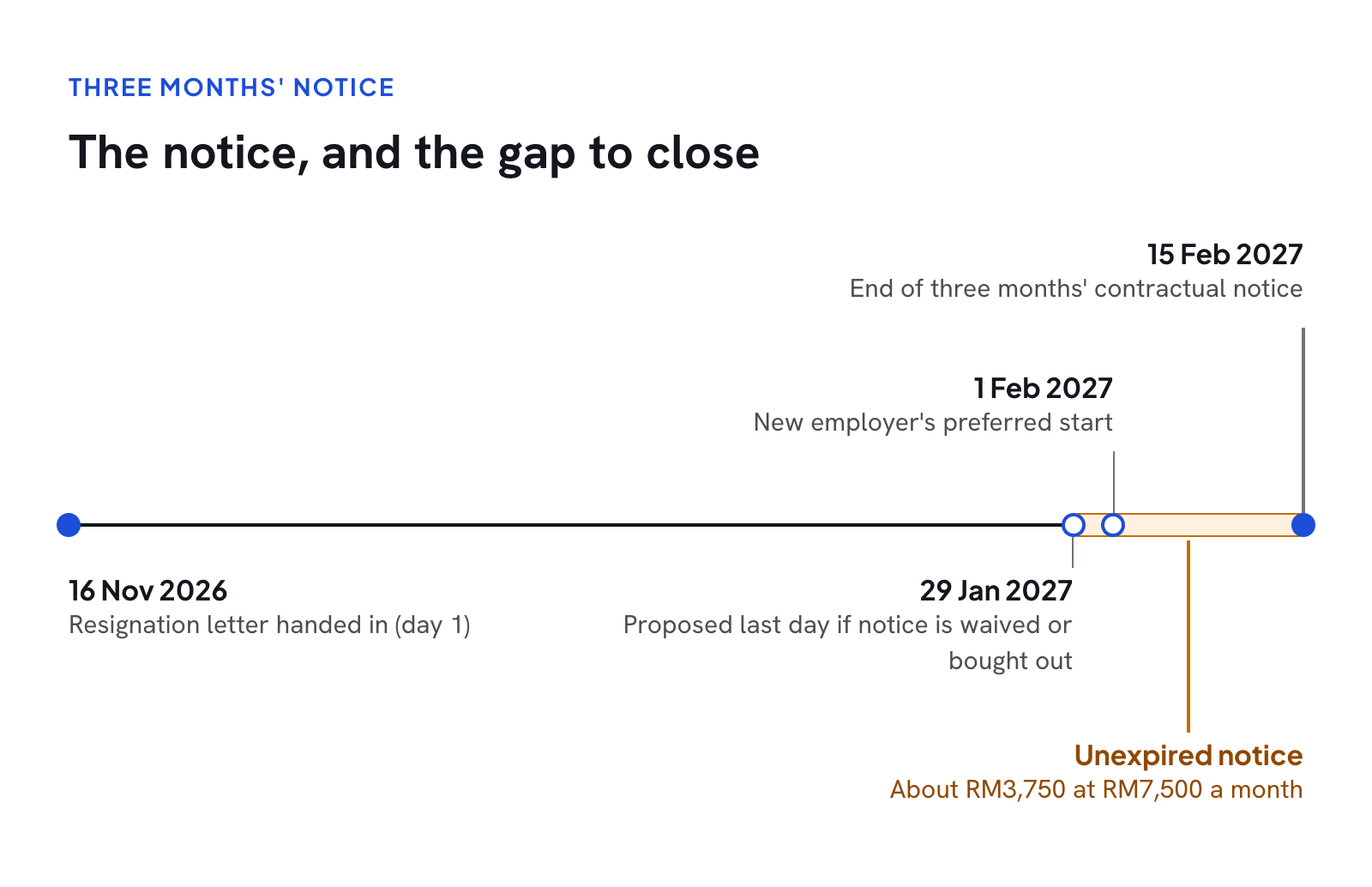
A finance executive at an engineering consultancy in Cyberjaya has a signed offer from a bank with a start date of 1 February 2027. The consultancy wrote three months' notice into the executive's contract. The resignation went in on 16 November 2026. Unless someone agrees to something, the executive is not free until 15 February, two weeks after the bank expects its new hire at the desk.
Most notice-period trouble looks like this. Nobody is breaking the law. Two documents simply disagree, and the person caught between them hasn't read either closely. This piece covers Peninsular Malaysia and Labuan, where the Employment Act 1955 applies. Sabah and Sarawak have their own Labour Ordinances, both amended from 1 May 2025 to bring them closer to the Act, but the section numbers below don't carry across.
What the Act says
Section 12 lets either side end the contract by giving notice. Since the 2022 amendments took effect on 1 January 2023, the Act covers anyone with a contract of service regardless of salary, so the old RM2,000 cut-off no longer keeps managers out. The RM4,000 threshold you may have heard about only switches off overtime, rest-day and holiday pay rules. It does not touch notice.
Three rules in section 12 matter most. The notice must be the same length for both employer and employee. It must be in writing, and the day you hand it in counts as day one. Where your written contract says nothing about notice, the minimums are:
four weeks if you have worked there for less than two years
six weeks for two years or more but less than five
eight weeks for five years or more
Length of service is measured on the date the notice is given, so a resignation sent a week before your second work anniversary still carries the four-week minimum.
When the contract says something different
Section 12(2) says the length of notice "shall be determined by a provision made in writing" in the contract, and the statutory weeks apply only where there is no such provision. So the contract is the first thing to read, and for most white-collar staff in the Klang Valley it says one, two or three months. If your contract says three months, three months is what you owe, even though the Act's fallback would have been four weeks.
The harder question is a contract that sets notice below the statutory minimum: two weeks for someone with six years' service, say. Section 7 voids any term less favourable than the Act, and lawyers argue over whether a short notice clause counts. If you are the one being let go on short notice, raise it. If you are the one leaving, the shorter figure works in your favour and few employers will chase it.
There is one situation where the contract cannot cut notice below the minimum at all. Section 12(3) says that when you lose your job because the business closes, moves, no longer needs your role, or changes owner, or because you refused a transfer your contract didn't require, you get at least the statutory four, six or eight weeks "regardless of anything to the contrary" in the contract.
The finance executive's numbers
The executive earns RM7,500 a month. The three months run from 16 November 2026 to 15 February 2027, counting the day of resignation. There are three ways to close the two-week gap.
The cleanest is a waiver. Section 12(2) has a proviso that lets either party waive its right to notice. The consultancy can simply agree to a release on 29 January. If they do, get it on paper. An email from HR confirming the agreed last day is enough. A manager saying "should be fine" in a corridor is not.
The second is to buy out the notice. Section 13(1) lets either side end the contract early by paying the other an indemnity equal to the wages for the unexpired notice. Leaving on 29 January means owing roughly half a month's pay, about RM3,750. Section 24(2)(b) allows the employer to deduct that from the final salary, so it rarely turns into a separate bill. Some new employers will cover a buy-out for a candidate they want. Ask the bank before you assume they won't.
The third is to ask the bank for a 16 February start. Hiring managers expect this conversation, and a two-week delay is rarely a deal-breaker for a permanent role. It costs the executive nothing.
Payment in lieu works both ways
Employers use section 13(1) too. If your company decides it would rather not have you in the office for six weeks after you resign, it can pay you the wages for the notice period and let you go that day. You lose nothing financially, and you can start your next job the following morning. Check that the payment covers the full unexpired notice and that your unused annual leave is paid on top.
The Act defines wages as basic pay plus other cash payments for work done, and it leaves out travelling allowances, reimbursements for work expenses, the employer's EPF share and annual bonuses. So a fixed monthly role allowance belongs in the calculation, while your petrol claims don't. Query it if the allowance is missing. Our guide to reading your payslip shows where each line comes from.
Garden leave
Garden leave is not in the Act. It comes from your contract, and it means the employer keeps you employed and paid through your notice but tells you to stay home and stay away from clients. You are still their employee until the last day. That means no starting the new job early, no consulting on the side and no client calls.
Our view is that garden leave on full pay is a good deal and you should take it gracefully. Read the clause first, though. Some contracts let the employer withhold commission or bonuses during garden leave, and a few tie it to a restraint on where you can work afterwards. How far such a restraint binds you is a contract-law question outside the Employment Act, and one worth a lawyer's hour before you sign the new offer.
Using annual leave during notice
Section 60E(2A) gives you the right, when your contract is ending, to take the annual leave you have earned before the termination takes effect. That includes the pro-rated leave for the completed months of the current year. Section 60E(3A) says that if the contract ends before you've taken it, the employer must pay you for each untaken day. The only exception is dismissal for misconduct under section 14(1)(a).
In practice this gives you two options. You can use your leave to finish earlier on the calendar while staying employed until the official last day, or you can work every day and take the cash. Many handbooks say leave "cannot be used to offset notice". If yours does, ask HR to put their reason in writing. The Act gives you the right to the leave, though the dates still need agreeing like any other leave.
Medical leave during notice works the way it always does. A valid MC is still paid sick leave under section 60F, and the notice period keeps running in the background. Falling sick does not extend your last day unless your contract says so.
Notice during probation
Section 12 applies to every contract of service, probationary ones included. Most offer letters set a shorter notice during probation, often two weeks or one month, rising once you're confirmed. That written term is what governs, which is why it's worth knowing exactly when your confirmation takes effect. A resignation sent the day after confirmation can carry three times the notice of one sent the day before. Our piece on probation rights covers confirmation letters and extensions.
Writing the letter
Keep it short. Say you are resigning, state the date the letter is given and the last working day you have calculated, and ask HR to confirm both. If you want a waiver or early release, ask for it in a separate sentence so a refusal doesn't muddy the dates. There's a template in our resignation letter guide.
Saving a job on Eternity Job keeps it in one list while you work out your dates, so you can compare closing dates with the day you'll actually be free.
If your employer refuses to pay wages or leave pay owed on your exit, you can file a claim with the Labour Department (JTK) under section 69 of the Act. It costs nothing, and you don't need a lawyer to start one.