Constructive dismissal in Malaysia: what counts and what to do
Eternity Job Career Team20 October 2026 · 7 min read
A regional sales manager at a property developer in Petaling Jaya came back from two weeks' leave to find the sales team reporting to someone else. The car allowance had disappeared from the next payslip. The title stayed on the manager's email signature and nowhere else. Nobody had fired anyone. It felt like being fired anyway.
That feeling has a legal name, and it is narrower than most people expect. Constructive dismissal means the employer's conduct was serious enough that you were entitled to treat the contract as ended, so your resignation counts in law as a dismissal. Get it right and you can bring an unfair dismissal claim. Get it wrong and you've resigned, with nothing to claim.
This is general information as of October 2026, not legal advice. The Industrial Relations Act 1967 applies across Malaysia. Where this piece refers to the Employment Act 1955, that covers Peninsular Malaysia and Labuan only. Sabah and Sarawak have their own Labour Ordinances.
The contract test
Malaysian courts ask one question: did the employer breach the contract in a way that goes to its root, or show it no longer intends to be bound by it? This is the contract test, adopted by the Supreme Court in a 1988 decision involving a cinema operator. In 2024 the Federal Court confirmed it again in a decision involving a bank, holding that the contract test is the legal test and that an employer's reasonableness is only a factor in deciding whether a fundamental breach occurred, as Free Malaysia Today reported.
An unpleasant boss isn't enough by itself. What matters is a broken term of your contract, written or implied, serious enough that the deal is effectively off.
Three things usually have to line up. There must be a breach, and a serious one. You must have resigned because of it, not because a better offer came along at the same time. And you must have acted reasonably promptly. Carry on working under the changed terms for months without objecting and you risk being taken to have accepted them.
What tends to count
Each case turns on its own contract and facts, so treat these as patterns rather than rules.
A pay cut, or the removal of a contractual allowance, without your agreement. Section 15(1) of the Employment Act says an employer who fails to pay wages in accordance with Part III of the Act is deemed to have broken the contract, which gives this kind of claim a statutory footing.
A demotion: losing your title, your reports or the core of your job while the paperwork says nothing has changed. The sales manager's case sits here.
A transfer to a different role or location that your contract doesn't allow. The 1988 cinema case itself involved a personnel manager abruptly ordered into cinema management.
Being stripped of all meaningful work and left at your desk with nothing to do, often as a nudge towards the door.
And what usually doesn't count: a transfer your contract's mobility clause expressly permits, a tough but fair appraisal, a manager you clash with, a restructure that leaves your pay, grade and substance of work intact. These can make a job miserable without breaching the contract.
The risk of resigning first
Here is the uncomfortable part. In an ordinary dismissal case the employer must prove it had just cause. In a constructive dismissal case you must first prove you were dismissed at all, meaning that the breach happened and was serious enough. If the Industrial Court decides it wasn't, your claim fails at the first hurdle and your resignation stands as a resignation.
So don't resign on the spot, however tempting it is. Do this instead.
Read your contract, offer letter and handbook. Find the clause you say was broken. If you can't find one, think hard about whether this is really a breach.
Write to your employer. Set out what changed, when, and which term it breaches, and ask for it to be reversed by a specific date. Keep it factual and polite. A short letter that says "my car allowance of RM1,200 was removed from my October payslip without my consent; please reinstate it and the arrears by 15 November" is worth far more than three pages of grievance.
Keep copies of everything on a personal device: payslips before and after, org charts, emails reassigning your team, your letter and their reply.
If the breach isn't put right, resign in writing and say plainly that you are leaving because of it, referring to your earlier letter. A resignation letter that thanks everyone for a wonderful five years and mentions nothing else will be read against you.
Don't let the gap between steps two and four drift. A few weeks is normal. Six months of silence looks like acceptance.
The 60-day limit
Section 20(1A) of the Industrial Relations Act says the Director General of Industrial Relations won't entertain a representation unless it is filed within 60 days of the dismissal. Where you are dismissed with notice, you can file during the notice period. Miss the deadline and the claim is generally lost, however strong it was.
For constructive dismissal, the date of dismissal is usually tied to your resignation. Treat the earlier date as your deadline and file well inside it.
How the process runs
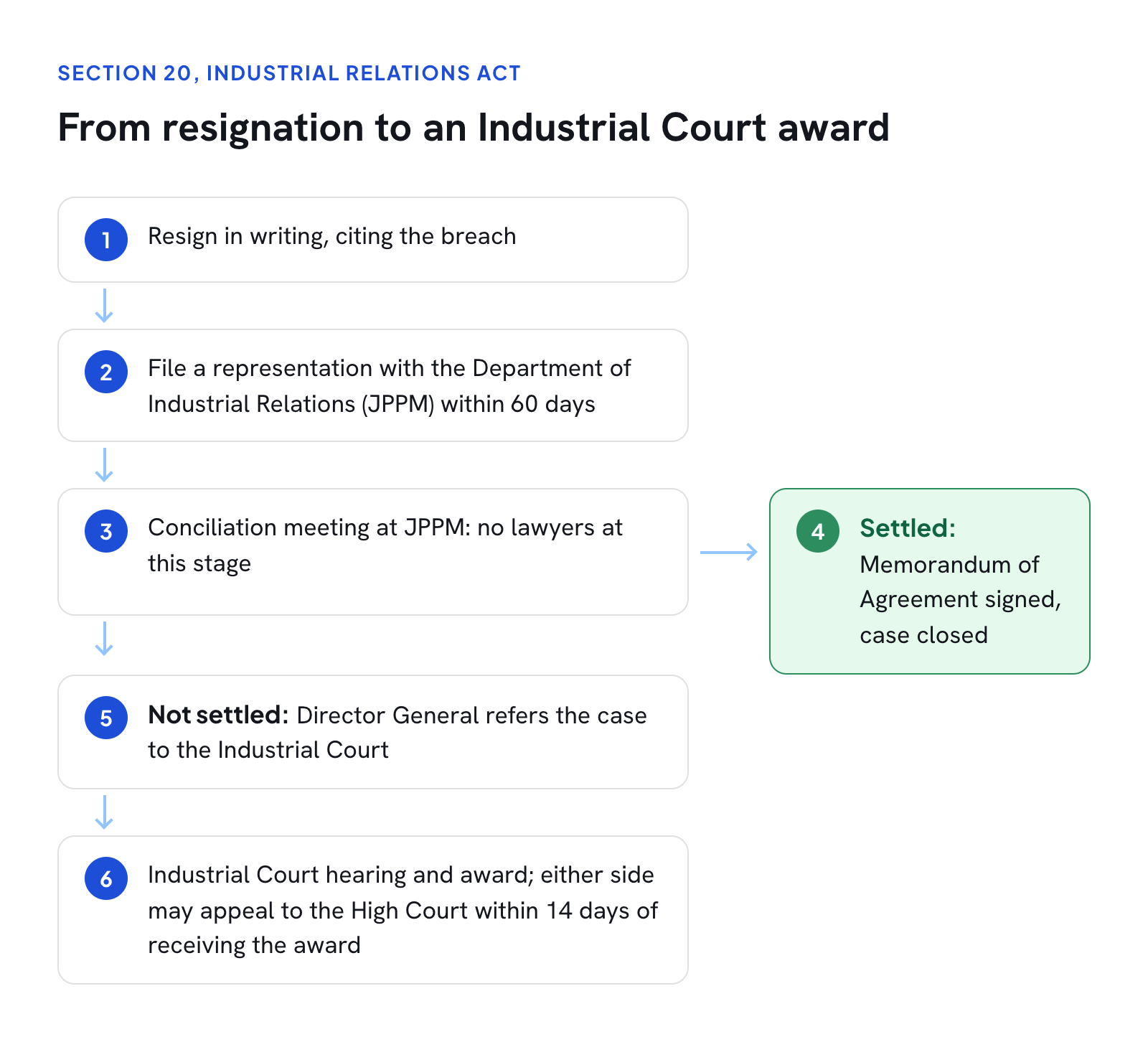
You file a written representation with the Department of Industrial Relations, known as JPPM. Its section 20 page says representations can be filed online through its IRIS system, and you can also go to the office nearest the workplace you left.
JPPM then calls both sides to a conciliation meeting. This is a settlement conversation, not a hearing. You can represent yourself, and JPPM says advocates are not permitted to represent parties at this stage. Many cases end here with a negotiated payment recorded in a Memorandum of Agreement. JPPM also warns that if you miss three scheduled meetings, the case may be treated as withdrawn.
If the Director General is satisfied there's no likelihood of settlement, the case is referred to the Industrial Court. Since amendments that took effect on 1 January 2021, that referral comes straight from the Director General rather than from the Minister, and an award can be appealed to the High Court within 14 days of receipt, according to this Skrine summary of the 2020 amendments.
The court can order reinstatement or compensation. The Act's Second Schedule caps backwages at 24 months from the date of dismissal at your last-drawn salary, or 12 months for a probationer. A percentage of anything you earned elsewhere after dismissal is deducted, and the award excludes loss of future earnings. Expect the whole thing to take many months.
When to bring in a lawyer or a union
If you're a union member, call your union before you send the first letter. Union officers handle these cases routinely, and the Act allows a union officer to represent you.
Get a lawyer's view before resigning if the stakes are high: a senior salary, a large deferred bonus, share options that lapse on resignation, or a contract with a restraint or clawback clause. An hour of advice costs far less than resigning on a case that doesn't meet the test. You'll also want a lawyer if the case is referred to the Industrial Court, where advocates can appear.
You don't need one to write the first complaint letter or file the representation, and plenty of people handle conciliation alone.
Before you accept your next role, read what current and former staff say about the employer on its company page. Reviews often show whether "restructuring" there tends to mean what happened to the sales manager in Petaling Jaya.
If you're still in the job and haven't decided anything yet, our pieces on probation rights and notice periods cover the ground either side of this one.