Overtime pay in Malaysia: how to calculate it
Eternity Job Career Team20 October 2026 · 8 min read
An accounts assistant at a freight forwarder in Port Klang is on RM3,200 basic, with a contract that says 8 hours a day, and in the last week of every month stays until 8pm closing the books. Last September the assistant also worked a Saturday, which is the contractual rest day, and Malaysia Day. The overtime came to RM800, to the sen. Most people in that position would have no idea whether that number was right, and some employers count on it.
The overtime rules in the Employment Act 1955 are short and quite precise. Once you know which ones apply to you, you can check your own pay in about five minutes. This guide covers Peninsular Malaysia and Labuan, where the Act applies. Sabah and Sarawak have their own labour ordinances. Everything here is as of October 2026.
Who is covered after the 2022 amendments
Until 2022 the Employment Act only protected people earning up to RM2,000 a month, plus manual workers. The amendments that took effect on 1 January 2023 extended the Act to everyone on a contract of service, according to the Labour Department's summary. But the First Schedule then carves a few provisions back out for higher earners.
Paragraph 1A of the First Schedule says that if your wages exceed RM4,000 a month, these do not apply to you: rest-day pay under section 60(3), overtime pay under section 60A(3), shift-work pay under section 60C(2A), public-holiday work pay under sections 60D(3) and 60D(4), and termination benefits under section 60J.
There is an exception that matters. Paragraph 2 of the same schedule keeps those protections for some workers whatever they earn: manual labourers, people who drive or maintain vehicles carrying passengers or goods, and anyone who supervises manual workers throughout their work. A warehouse supervisor on RM5,500 still gets statutory overtime.
How the RM4,000 line is measured
The threshold does not use your total pay. Paragraph 3 of the First Schedule defines wages for this purpose as wages under section 2 of the Act, minus commissions, subsistence allowance and overtime payments. Section 2 already excludes things like travel allowance, the employer's EPF contribution and annual bonus.
So fixed cash allowances count towards the RM4,000, but commission and overtime do not. Two people on the same take-home can land on opposite sides of the line:
Sales coordinator
Basic RM3,600 + commission RM900 = RM4,500 paid
Wages for the First Schedule:   RM3,600   -> covered

IT support executive
Basic RM3,700 + fixed allowance RM500 = RM4,200 paid
Wages for the First Schedule:   RM4,200   -> not covered
If you are just above the line, check your offer letter for what is called basic and what is called allowance. That wording decides whether you have a statutory right to overtime pay.
Step one: your ordinary rate of pay
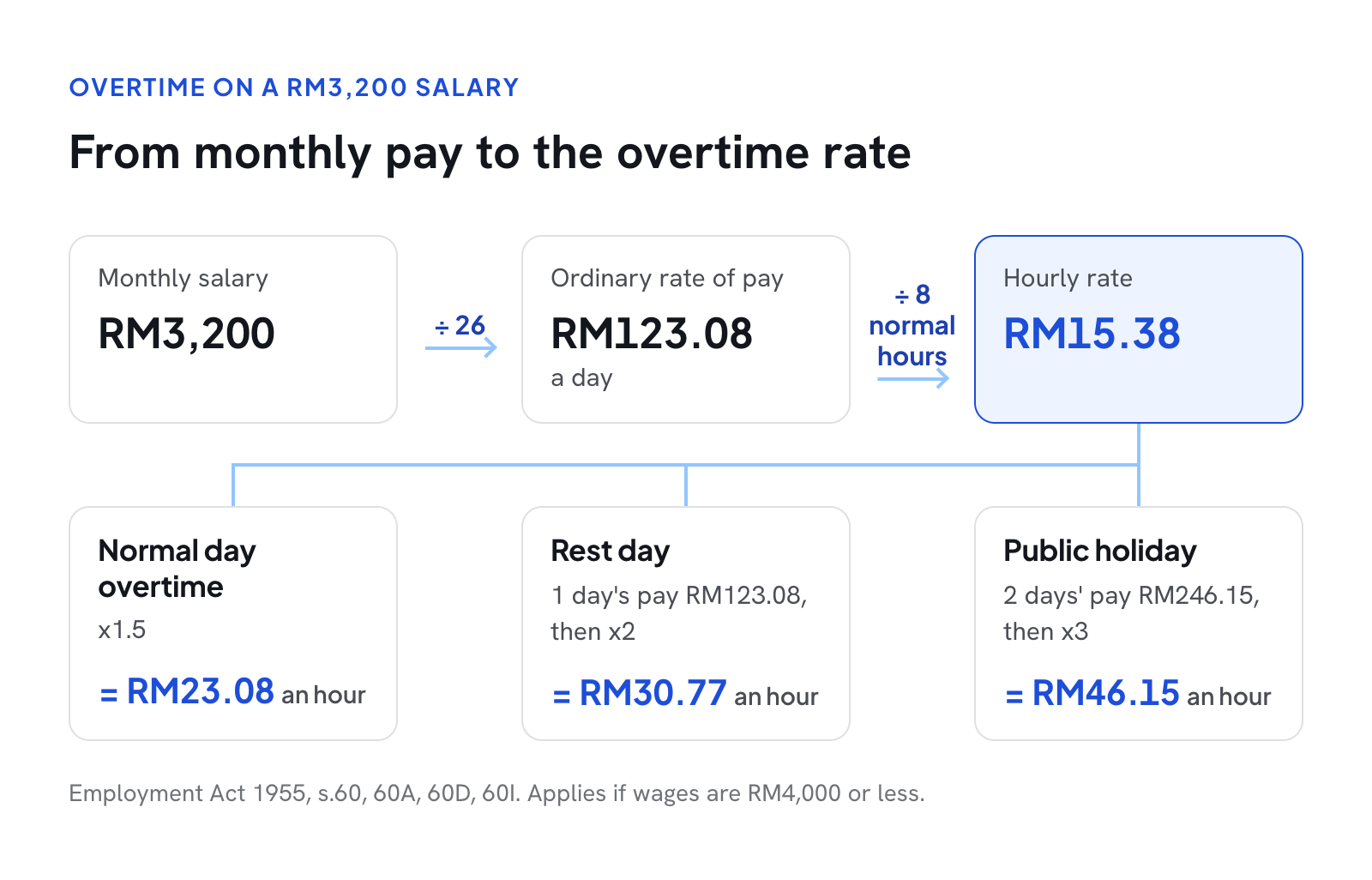
Every overtime calculation starts from your ordinary rate of pay, which is a day's wages. For anyone paid monthly, section 60I(1A) fixes the formula:
Ordinary rate of pay = monthly rate of pay / 26
Hourly rate of pay   = ordinary rate of pay / normal hours of work per day
The divisor is 26 whether you work a five-day or six-day week. Your normal hours are the daily hours agreed in your contract, which cannot exceed 8 a day or 45 a week under section 60A(1), except that a contract with shorter days elsewhere in the week can stretch a day to 9 hours. If your contract says 9 hours a day, divide by 9.
For the accounts assistant:
RM3,200 / 26 = RM123.08 a day
RM123.08 / 8 = RM15.38 an hour
The "wages" in the formula are wages as section 2 defines them, so a fixed monthly allowance paid for work done belongs in the monthly figure along with basic pay. Some employers calculate on basic pay alone. Section 60I(2) allows them to use another formula only if it doesn't produce a lower rate.
Step two: the rate for each kind of day
Normal working days: 1.5 times
Overtime is any work beyond your normal hours for the day. Section 60A(3) sets the minimum at one and a half times your hourly rate. There is also a spread-over rule: your working day, breaks included, should not span more than 10 hours, and anything worked after that 10-hour span counts as overtime even if your actual working hours were fewer.
Rest days: a day's pay, then 2 times
Your rest day is usually Sunday, or Saturday if you work a five-day week, but it is whatever your contract names. Section 60(3)(b) pays monthly-rated employees for rest-day work in addition to their salary:
Up to half your normal hours: half a day's ordinary rate
More than half, up to your normal hours: one full day's ordinary rate
Beyond your normal hours on a rest day: at least 2 times your hourly rate
Daily and hourly-rated employees get double those day rates under section 60(3)(a).
Public holidays: 2 days' pay, then 3 times
You are entitled to 11 paid public holidays a year under section 60D, five of them fixed: National Day, the Agong's birthday, your state Ruler's birthday or Federal Territory Day, Workers' Day and Malaysia Day. Your employer picks the other six from the gazetted list and must post them before the year starts, so a holiday your friends get off may be a normal working day for you. If your employer asks you to work on one, section 60D(3) pays two days' wages on top of the holiday pay you already receive, however few hours you work. Any hours beyond your normal hours that day are paid at no less than 3 times your hourly rate.
A full month worked through
Here is the assistant's September, using an hourly rate of RM15.384 before rounding:
Hourly rate: RM3,200 / 26 / 8 = RM15.384

Weekday overtime, 10 hours x 1.5 x 15.384     RM230.77
Rest day, worked a full 8 hours (1 day)       RM123.08
Rest day, 2 hours beyond 8 x 2 x 15.384        RM61.54
Public holiday, worked 8 hours (2 days)       RM246.15
Public holiday, 3 hours beyond 8 x 3 x 15.384 RM138.46
                                              --------
Total overtime and holiday pay                RM800.00
All of that sits on top of the RM3,200 basic. Overtime is not liable for EPF, according to KWSP's list of exempt payments, so the EPF line on the payslip should not move. SOCSO and PCB both take overtime into account, so those will.
Had the assistant worked only three hours on the rest day, the pay would have been half a day's pay, RM61.54, instead of the full RM123.08. That half-day threshold catches people out. Working four and a half hours on a Saturday instead of four is worth another RM61.54.
The 104-hour cap
Your employer cannot make you work unlimited overtime. The Employment (Limitation of Overtime Work) Regulations 1980 set the limit at 104 hours in any one month. Work on a rest day or a public holiday does not count towards it, under the proviso to section 60A(4). The Director General of Labour can approve more for particular employees, and section 60A(7) separately bars any employer from requiring more than 12 hours of work in a day outside genuine emergencies.
The cap sits in section 60A(4), which the First Schedule does not exclude, so on a plain reading it limits hours for higher earners too, even though they have no statutory right to be paid for them.
In practice, 104 hours is a lot. It is roughly five extra hours every working day. If you are anywhere near it, the pay is the smaller problem.
If you earn more than RM4,000
Above the line, overtime is a matter for your contract. Plenty of MNCs and banks pay it anyway, often at the same 1.5, 2 and 3 multiples because their payroll systems were built that way. Others give time off in lieu, a flat allowance or nothing, and say so in the offer letter.
It is worth asking before you sign, especially in audit, consulting and some tech roles where long months are expected. "How are late nights at quarter-end recognised?" is a fair question at the offer stage and much harder to raise a year in. Our guide to negotiating a job offer covers how to put it.
Every job ad on Eternity Job shows its salary range on the card. If a role sits just above RM4,000, check whether that figure is basic pay or basic plus allowances before you assume overtime is covered.
When the numbers don't add up
Start by asking HR how your overtime was calculated, in writing. Many errors come from using basic pay instead of wages, dividing by 30 instead of 26, or treating rest-day work as ordinary overtime.
If that goes nowhere, you can file a complaint with the Labour Department (JTK) through its complaints channels, including the Working for Workers app, or bring a monetary claim in the Labour Court. Bring your contract, payslips and a simple record of the hours you worked. Clock-in data, emails sent late and messages from your manager asking you to stay all help.
Overtime shows up as a separate line on your payslip, usually under earnings. If you want to check the deductions that follow it, see how to read your payslip.