Moving from an SME to an MNC in Malaysia, or the other way round
Eternity Job Career Team20 October 2026 · 8 min read
A finance manager spent five years at a 40-person building-materials distributor in Kepong, closing the books, chasing debtors, sitting with the auditors, handling the bank, and once fixing the office printer. An application to a multinational's shared-services centre in Cyberjaya brought back an offer for a Senior Analyst. The finance manager nearly turned it down out of pride. The pay was 25% higher.
Moving between a small local company and a multinational is one of the most common career changes in the Klang Valley, and one of the most misunderstood. Each side undersells what the other teaches. You will do better if you understand what you are trading.
What counts as an SME here
SME Corp. Malaysia's definition (as of October 2026) caps a manufacturing SME at RM50 million in sales or 200 full-time employees, and a services SME at RM20 million or 75 employees. Subsidiaries of multinationals and GLCs are excluded, even when they are small. So the 30-person local office of a European software firm is not an SME, however much it feels like one.
That matters because many "MNC" jobs in Malaysia are in small regional offices. The ones that feel most like a big company are the shared-services and global business-services centres clustered in Cyberjaya, Bangsar South and KL Sentral, and the regional headquarters along Jalan Ampang and in TRX.
The honest trade-offs
Scope
In an SME you do the whole job and several adjacent ones. The Kepong finance manager's role covered what an MNC would split across accounts payable, accounts receivable, general ledger, treasury and tax. It meant knowing the business end to end, and making decisions without a committee.
In an MNC your scope narrows and deepens. You might own intercompany reconciliations for six markets. That sounds small until you realise the volumes, the systems and the controls around them are on a different scale. You learn to do one thing to a standard the SME never needed.
Neither is better. But the narrowing is real, and some people hate it within three months.
Pace and decisions
SMEs move fast when the owner agrees and not at all when they don't. Your influence depends on your relationship with one or two people. An MNC moves slowly and predictably. Approvals take longer, but they rarely reverse because the boss had a bad weekend.
Structure and promotion
MNCs have job grades, salary bands, annual performance cycles and a published path from one level to the next. You will know what it takes to get promoted. You may also wait two years for it because the band above you is full.
SMEs often have no formal grades at all. Promotion happens when the business grows or someone leaves, and the title can jump overnight. That is a real advantage for people who are good and impatient.
Pay
Pay is where people make the most assumptions. At junior and mid levels, multinationals in KL generally pay more for the same function, and pay it more predictably: fixed bands, an annual increment cycle, and often a bonus formula you can read. Recruitment firms such as Hays and Robert Walters publish annual salary guides for Malaysia that break pay down by role and seniority, and they are the best public reference if you want ranges for your function.
Senior SME roles are the exception. A capable general manager or finance head at a profitable family business can be paid well, sometimes with a profit share no MNC band would allow. The catch is that it is negotiated person by person, and it can stop when the business has a bad year.
Benefits
MNCs usually win here, and by a margin. Expect more annual leave than the statutory minimum, group hospitalisation and outpatient cover that extends to your family, sometimes employer EPF above the statutory rate, and structured parental leave. SME benefits range from excellent to the legal minimum. Ask for the benefits summary before you accept, and compare it line by line. Our guide to medical, maternity and paternity leave sets out the statutory floor.
Title inflation
Titles in small companies run higher than the same work would earn in a large one. An SME "Finance Manager" with no direct reports often maps to a Senior Analyst or Assistant Manager at an MNC. An SME "Head of Marketing" running a team of two might be a Marketing Manager elsewhere.
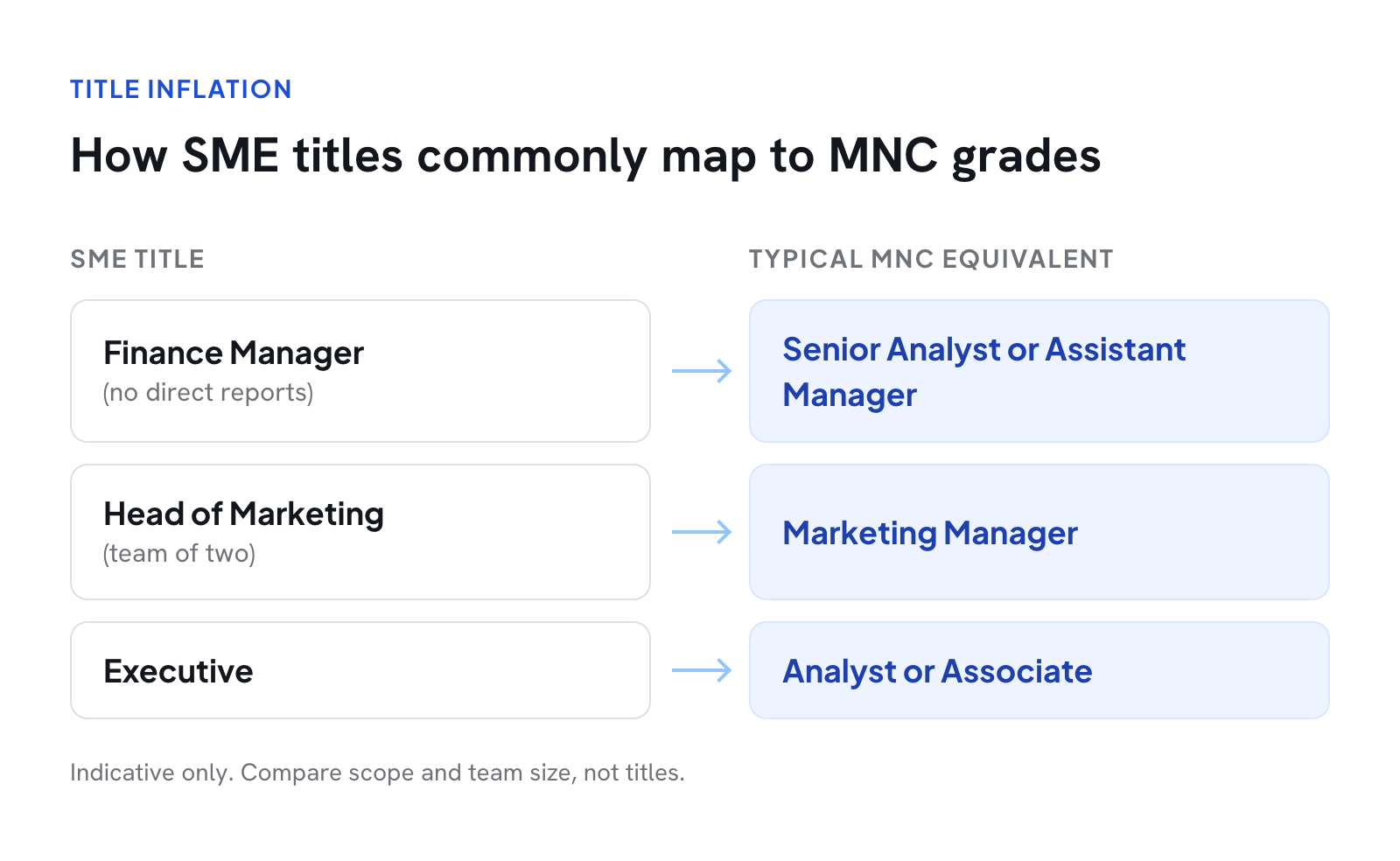
This is the single biggest source of disappointment for people moving to an MNC, and of over-optimism for people moving the other way. Judge the move by pay, scope and the next step it opens up. The title will even itself out within a few years.
Moving from an SME to an MNC
Your problem is that a recruiter at a multinational will not know what your title means. Fix that on your CV before you apply.
Describe scale in numbers. "Managed month-end close for a company with RM60 million turnover and 3 entities" tells an MNC reader exactly what you handled.
Name the systems. If you used SQL Account, AutoCount or a cloud ERP, say so. If you moved the company from spreadsheets to an ERP, that is a project, and MNCs love projects.
Separate your hats. List the distinct responsibilities you carried, because each one maps to a role they hire for.
Show you can work to a process. Audit sign-offs, internal controls you introduced, any SOP you wrote. The worry an MNC has about SME candidates is that they improvise. Answer it before they ask.
Be ready for a lower title. Negotiate on pay and grade, and let the business card go.
The finance manager's interview turned on one answer. Asked about a disagreement with an auditor, the candidate described a specific revenue-recognition issue and the memo written to resolve it. That told the panel the candidate could document, which was the thing they doubted.
Expect to be slower for the first six months. You will spend time learning who approves what, and which system holds the truth. Probation at a multinational is usually more formal, with a mid-point review and set objectives. Read up on your probation rights before you start.
Moving from an MNC to an SME
A regional marketing executive left a consumer-goods multinational in Mid Valley to become the first marketing hire at a 60-person furniture maker in Shah Alam. The first month was a shock. There was no brand guideline, no agency on retainer, and no budget line until the new hire wrote one.
Here, your problem is the opposite. The SME owner is wondering whether you can do anything without a team, a budget and a regional office behind you.
Lead with things you did yourself. Strip out "supported", "partnered with" and "coordinated" where you can, and say what you personally produced.
Talk in money. Sales, cost saved, margin protected. Owners think in ringgit.
Show range. If you ever covered a colleague's job, ran a project outside your function or worked with a tiny budget, put it near the top.
Show you will not rebuild the MNC. Say you will bring the habits that matter and leave the bureaucracy behind. Then mean it.
Ask hard questions about the business. Who makes decisions, how it is funded, what happened in the last downturn, and whether anyone in your role has stayed longer than two years.
Check the company properly before you go. An SME's culture is mostly the owner's personality, and you will meet it every day.
Company pages on Eternity Job carry reviews from people who have worked there. For a small employer, they are often the only outside view you will get.
Our guide to reading company reviews explains how to weigh them.
Which way should you go
Go to a multinational if you want structure, training, benefits and a brand on your CV that every future recruiter recognises. It is the better move in your twenties for most people, because the systems you learn there travel.
Go to an SME if you want range, speed and access to the people who decide. It is the better move once you know your craft and want to own an outcome. It is also where people discover whether they want to run a business one day.
The finance manager took the Senior Analyst job, and two years later was an Assistant Manager leading the same reconciliation team, earning more than ever before in Kepong. The marketer is still in Shah Alam, now with a team of three, and would not go back.