Working in Singapore or staying in KL: the real numbers for 2026
Eternity Job Career Team20 October 2026 · 8 min read
A backend engineer at a fintech in Bangsar South, 30, earning RM14,000 a month, got an offer from a Singapore company in September: S$7,500. At Bank Negara's middle rate of RM3.1919 to the Singapore dollar on 20 October 2026 (BNM), that is about RM23,939 a month. The engineer's friends said to sign immediately.
The numbers deserve a proper run first. Some of them are better than they look, and one of them could stop the move altogether.
Which work pass, and what it takes
Malaysians need a work pass to be employed in Singapore. For graduate professionals it is usually one of two, both issued by the Ministry of Manpower (MOM), and both with a minimum monthly salary that rises with your age.
Employment Pass (EP)
For professionals, managers and executives. As of October 2026, MOM's EP eligibility page sets the qualifying salary at:
S$5,600 a month at age 23 or below, rising to S$10,700 at 45 and above (S$7,223 at age 30).
In financial services, S$6,200 rising to S$11,800 (S$7,982 at age 30).
These apply to new applications before 1 January 2027. MOM has already announced the next increase:
From 1 January 2027 for new applications: S$6,000 rising to S$11,500 (S$7,750 at age 30).
In financial services: S$6,600 rising to S$12,700 (S$8,541 at age 30).
Renewals move to the new figures for passes expiring from 1 January 2028.
Meeting the salary is the first stage. The application also has to score at least 40 points under COMPASS, MOM's points framework, which looks at your salary against local norms for the role, your qualifications, and the employer's workforce profile.
S Pass
For mid-skilled staff, often diploma holders. MOM's S Pass page sets the current minimum at S$3,300 at age 23 or below, rising to S$4,800 at 45 (S$3,800 to S$5,650 in financial services). From 1 January 2027 for new applications, it becomes S$3,600 to S$5,100, and S$4,000 to S$5,650 in financial services.
What this means for the engineer
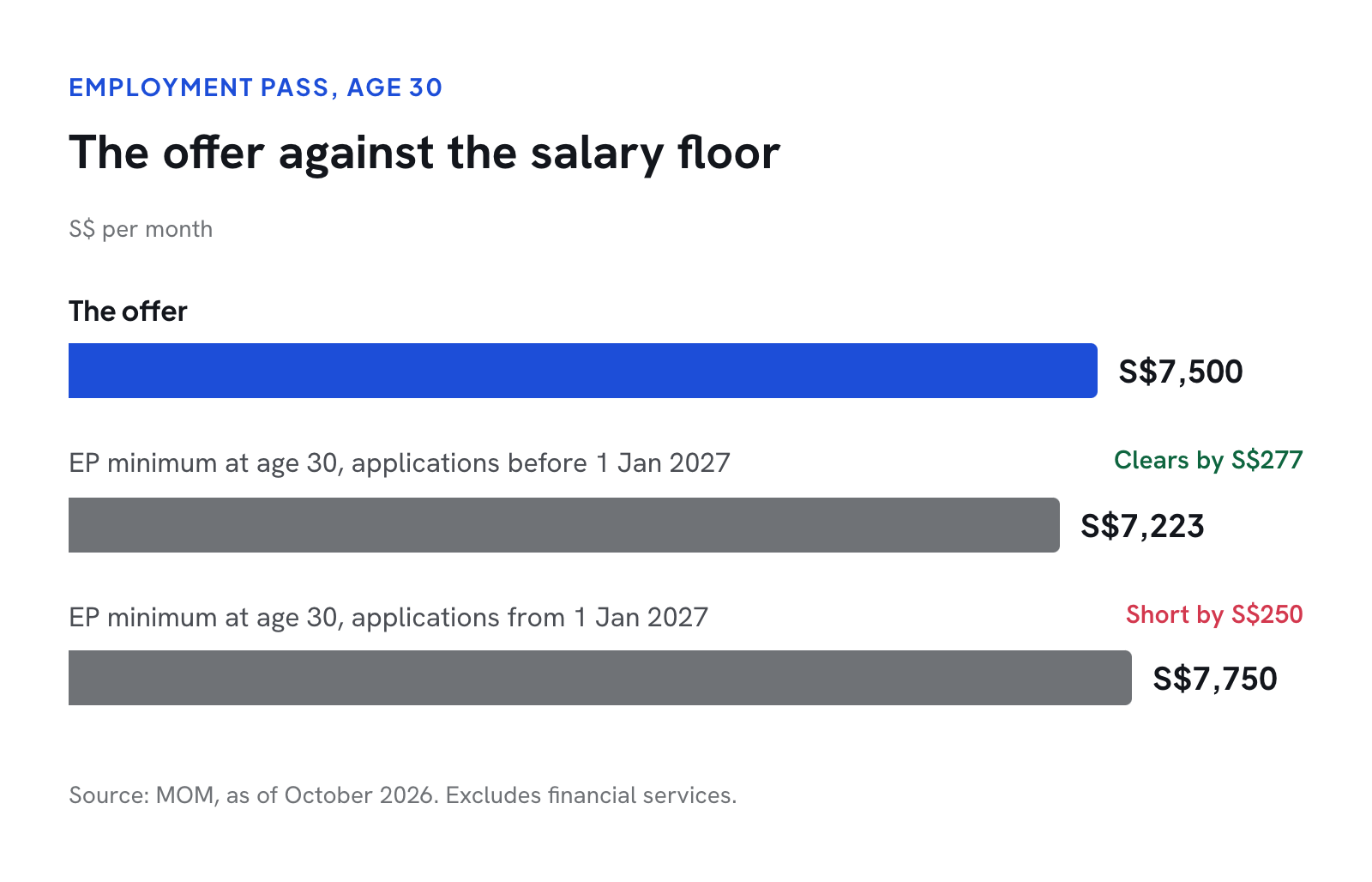
S$7,500 clears the current floor for a 30-year-old by S$277. It falls S$250 short of the 2027 floor. If the employer files after New Year, the engineer's application fails on salary alone, before COMPASS is even considered. The company has to submit in 2026, or raise the offer.
This is the single most useful thing to check before you resign in KL. Ask the employer which month they plan to apply, and do the sum against your age yourself.
CPF does not apply to you
Singaporeans and PRs pay into the Central Provident Fund, and their employers add to it. Foreigners on an EP or S Pass do not. The CPF Board says contributions are paid for Singapore Citizens and Permanent Residents, and its employer guidance states that contributions are not allowed for foreigners on these passes.
That cuts both ways. Your gross salary is close to your cash salary, which is why Singapore payslips look so generous to Malaysians. But you lose an employer retirement contribution entirely. In KL, the engineer's employer pays 12% of wages into EPF on top of salary, about RM1,680 a month on RM14,000. In Singapore, nobody does. When you compare offers, add your KL employer's EPF share to your KL salary. You can still make voluntary contributions to EPF from Singapore, but that comes out of your own pocket.
Tax: where residency changes everything
Singapore
Singapore taxes employment income earned there, whatever your nationality. How much depends on whether IRAS treats you as resident for the year.
According to IRAS, as of October 2026, a foreigner is resident if they stayed or worked in Singapore for at least 183 days in the calendar year. There are concessions: three consecutive years of work make all three resident years, and a stay of 183 continuous days spanning two calendar years can make both resident.
A non-resident pays tax on employment income at a flat 15% or at resident rates, whichever is higher, and cannot claim personal reliefs.
Resident rates are progressive. Under IRAS's rate table the first S$20,000 is untaxed, then 2%, 3.5%, 7% up to S$80,000, then 11.5% to S$120,000, climbing to 24% above S$1 million.
Here is the engineer on S$90,000 a year, before any reliefs:
As a resident: S$0 on the first S$20,000, S$200 on the next S$10,000, S$350 on the next S$10,000, S$2,800 on the next S$40,000, and S$1,150 on the last S$10,000. Total S$4,500.
As a non-resident: 15% of S$90,000 is S$13,500, which is higher than S$4,500, so the bill is S$13,500.
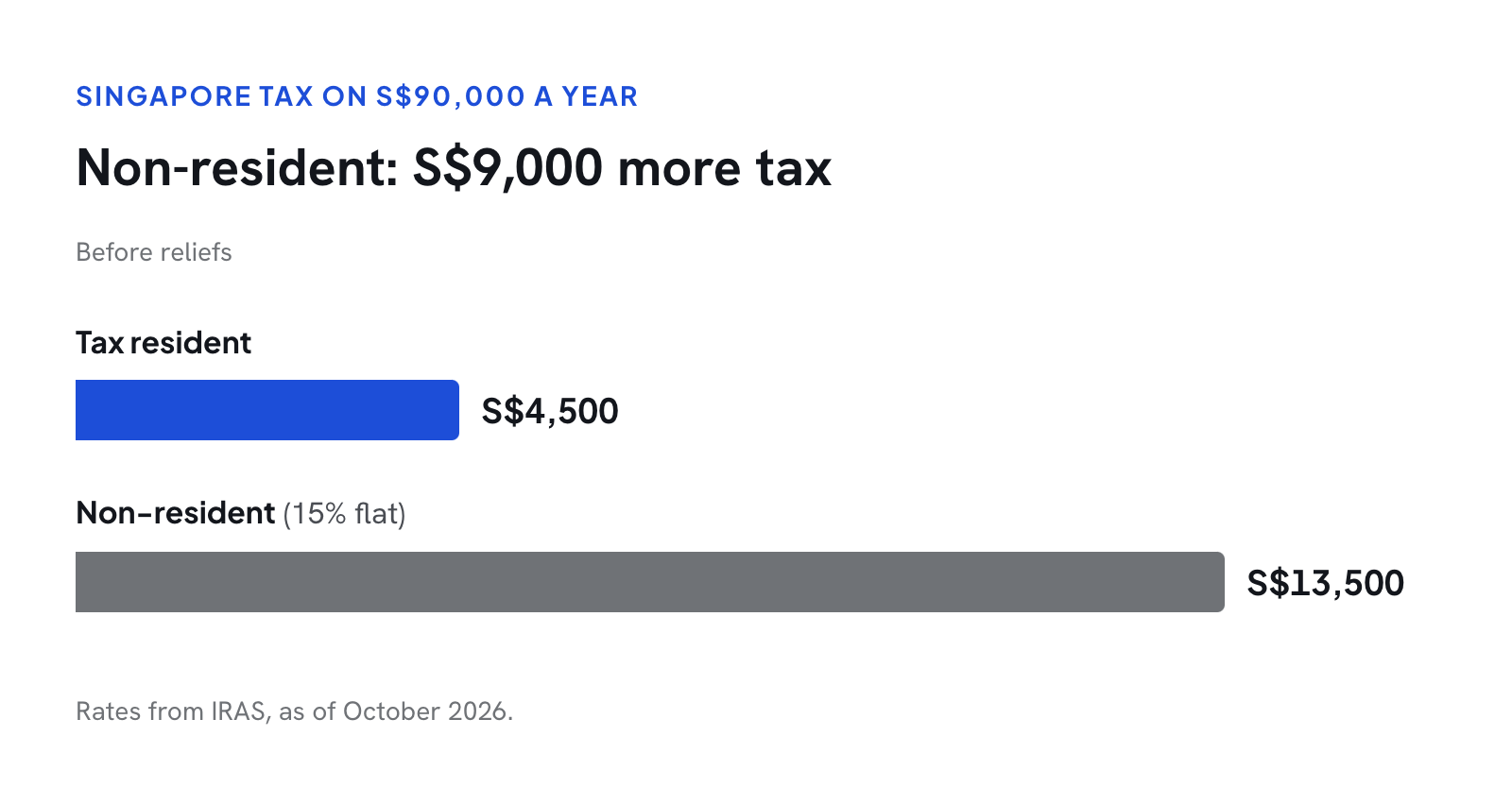
The gap is S$9,000. An engineer who starts in Singapore in November will spend fewer than 183 days there in the first calendar year. Whether the concessions apply depends on how long the stay lasts. Start dates matter more than people expect.
Malaysia
LHDN's test runs the other way. Under its guidance on non-residents, you are non-resident in Malaysia for a year if you are here for fewer than 182 days. If you move to Singapore and live there, you will usually become a Malaysian non-resident, and your Singapore salary is outside Malaysian tax because the work is done abroad.
If you live in Johor Bahru and commute, you stay a Malaysian tax resident. Malaysia currently exempts resident individuals' foreign-sourced income in most cases, but check the conditions for your situation.
The JB commute
A great many Malaysians live in Johor Bahru and work in Singapore, paying JB rent on a Singapore salary. On paper it is the best of both. In practice it costs time, and the time is unpredictable. The Causeway and the Woodlands Checkpoint jam badly at peak hours, and many commuters leave home before dawn.
Two changes are coming. The RTS Link, a 4km rail line from Bukit Chagar in JB to Woodlands North, was still on track to open by the end of 2026 as of its February 2026 train demo, with a crossing of about five minutes. If it opens on time it will change the commute for anyone who can live near Bukit Chagar.
On tax, a daily commuter is physically in Singapore on every working day. Five days a week across a year will often pass 183 days, which would make you a Singapore tax resident.
The cost of living
Housing is where the Singapore salary goes. You will almost certainly rent, and rent is the line that most often shocks people used to paying for a whole unit in Mont Kiara or Bangsar. Food at a hawker centre is good value; almost everything with a service charge is not. Owning a car in Singapore is expensive enough that most newcomers do without one, so budget for public transport and Grab.
We have not quoted rental figures, because they move quickly and vary sharply by area. Before you accept, check current listings for rooms near your office, and price your weekly groceries in Singapore dollars. Then convert at the rate on the day you decide, not the rate on the day you were made the offer.
Most job cards on Eternity Job show the salary range. Before you compare a Singapore offer, look at what roles like yours are paying in KL right now, so you are comparing against the market and not just your current payslip.
What you give up
Some of what you leave behind has no exchange rate.
Your employer's EPF contribution, as above.
Security of status. An EP is tied to your employer. If you lose the job, the pass goes with it, and you need a new employer to apply for another.
Family time. Weekend trips home are easy from JB and expensive from Jurong.
Your KL network. Promotions and referrals in KL often run through people. Two years away is long enough to fall out of the conversation.
Notice and timing. Your KL notice period sets your start date, and in 2026 that start date can decide your pass. Read our guide to notice periods before you resign.
What you gain is real too. The salary, converted, is often far above anything available for the same role in KL. Singapore experience reads well to regional employers. And many people simply want to try living somewhere else.
The engineer asked the Singapore company to file the EP in November, and countered at S$8,000 to leave room above the 2027 floor. The company agreed to S$7,800. A raise conversation is already pencilled in before the first renewal, because the floor rises with age and the renewal will be checked against the 2027 schedule. If you are weighing a counter of your own, our guide to negotiating a job offer has the scripts.