Resignation letter templates: standard notice, and 24-hour notice with payment in lieu
Eternity Job Career Team20 October 2026 · 9 min read
Don't resign until the new offer is signed. A verbal "we'd love to have you" from a hiring manager is not an offer, and neither is an email saying the paperwork is on its way. Wait for the letter, sign it, check the start date, and only then write to your current employer.
Once you're there, the resignation letter itself is the easy part. It should be short, polite and boring. What takes more thought is the notice: how long you owe, whether you can leave sooner, and what it costs if you do.
How much notice you owe
Your contract decides first. Under section 12(2) of the Employment Act 1955, the length of notice must be the same for employer and employee, and it is whatever the written contract says. Most white-collar contracts in the Klang Valley set one, two or three months, often stepping up with seniority or after confirmation.
If the contract says nothing about notice in writing, the Act sets a minimum based on how long you've worked there on the day you give notice:
Less than two years: four weeks
Two years or more, but less than five: six weeks
Five years or more: eight weeks
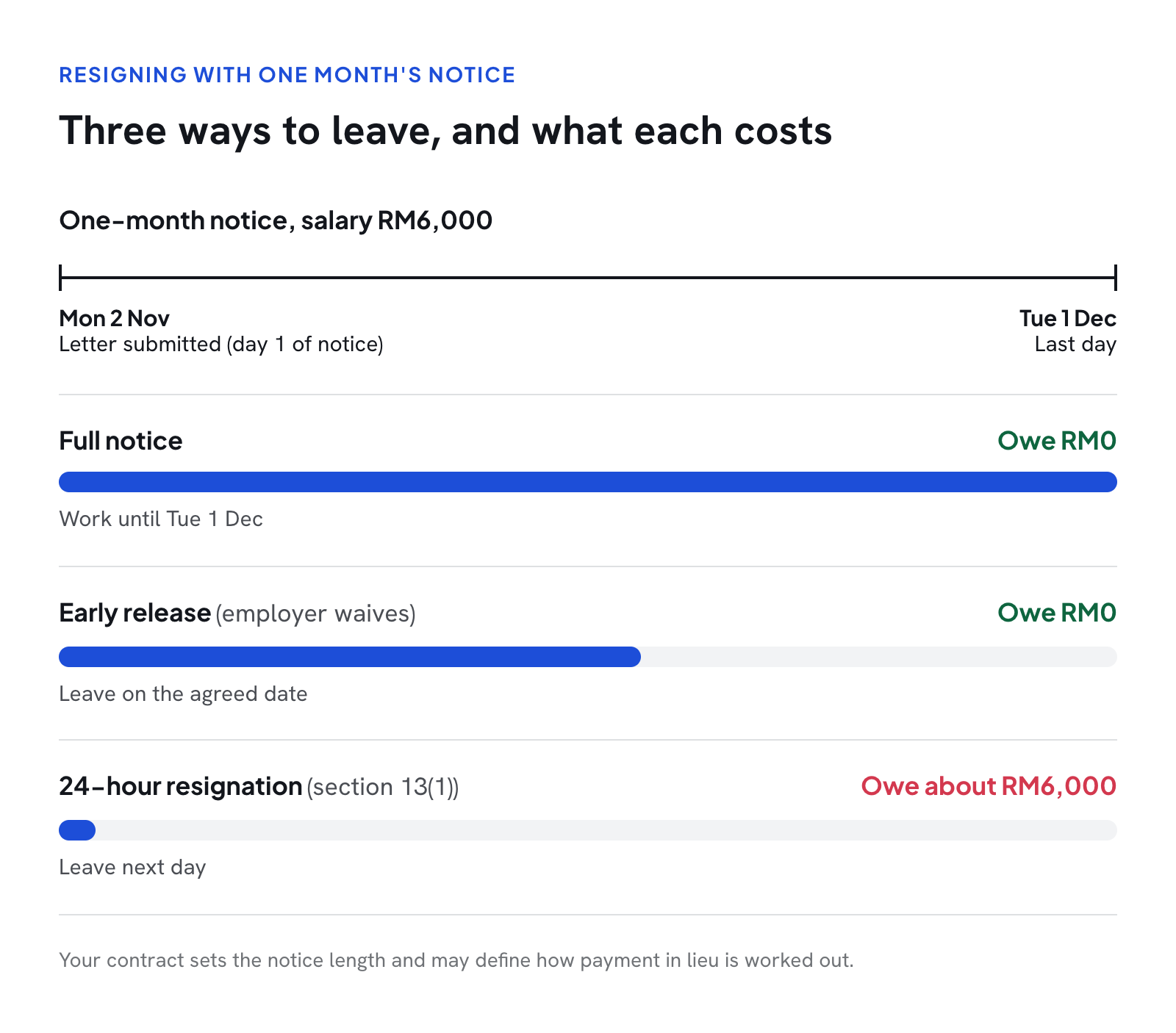
Notice has to be in writing, and section 12(4) says the day you hand it in counts as the first day of the notice period. So if your notice is one month and you submit your letter on Monday 2 November, your notice ends on Tuesday 1 December, and that is your last day.
As of October 2026, the Employment Act covers every employee in Peninsular Malaysia regardless of salary, following the 2022 amendments that took effect on 1 January 2023. The First Schedule switches off a handful of provisions for people earning more than RM4,000 a month, mainly overtime, rest-day and public holiday pay and termination benefits. Sections 12 and 13 are not among them, so the rules here apply to a RM15,000 manager as much as to a RM3,000 executive. Sabah and Sarawak have their own labour ordinances, so check those if you work there.
For more on how notice periods are set, negotiated and sometimes argued over, see our guide to notice periods in Malaysia.
Leaving early: the 24-hour resignation
"24-hour resignation" is the everyday name for something the Act calls termination without notice. Section 13(1) lets either party end the contract without notice, or cut short notice already given, by paying the other an indemnity equal to the wages that would have accrued during the notice period, or the unexpired part of it.
In plain terms, you can buy out your notice. If your notice is one month and your monthly salary is RM6,000, leaving with 24 hours' notice means you owe your employer about RM6,000. If you've already served two weeks of that month and want to stop, you owe roughly the wages for the remaining two weeks.
You don't usually hand over a cheque. Section 24(2)(b) allows your employer to deduct the indemnity from your final wages, and that's how most companies handle it. If your final salary doesn't cover the amount, the balance is still owed, and employers can pursue it.
Two details to check in your own contract:
What counts as "wages". The Act measures the indemnity in wages. Many contracts say "basic salary" instead, or set out their own formula. If yours does, that's the figure to use.
Whether it mentions payment in lieu at all. Some contracts say the employer "may" accept payment in lieu, which gives them room to argue. Few employers want to keep an unwilling employee for six more weeks, but read the clause before you plan around it.
Section 13(2) is separate: either side may end the contract without notice if the other has wilfully broken a condition of it. That is a much bigger step than buying out notice, with its own risks, and if that's your situation you should read our guide to constructive dismissal before you write anything.
The cheaper way out: ask to be released
The proviso to section 12(2) says either party may waive their right to notice. Your employer can simply agree to let you go early, for nothing. This happens more often than people expect, especially when your work can be handed over in a few days, or when you're moving to a competitor and the company would rather you weren't around client files.
So before you pay to leave early, ask. Speak to your manager first, explain the start date you've been given, offer a clear handover plan, and then put the request in writing. If they agree, get the agreed last day confirmed in an email or letter from HR. A verbal "okay lah, go" from your manager is not something you want to rely on when your final payslip arrives.
Using your annual leave to shorten your notice is another common request. Whether it's allowed depends on your contract and the company's policy. Many employers refuse, because they'd rather pay out the leave and keep you for the handover. Ask, and get the answer in writing.
When your final pay arrives
The Act sets deadlines. If your employment ends by notice under section 12, section 20 says your wages must be paid no later than the day the contract ends. If you terminate without notice under section 13, section 21(2) gives the employer until the third day after you leave to pay what you've earned, less lawful deductions such as the indemnity.
Ask HR for a written breakdown of the final settlement: the salary to your last day, any leave encashment, any bonus or commission owed under your contract, and any deductions. If something looks wrong, raise it before your last day, while the people who can fix it still answer your messages. Our guide to reading your payslip covers the standard deductions.
How to resign without burning anything
Tell your manager in person or on a call before the letter lands in their inbox. A resignation letter that arrives cold, with no conversation, is the one thing people remember about an otherwise good colleague.
Keep the conversation short. You don't owe a long explanation, and the meeting is no place to air grievances. If you want to give honest feedback, the exit interview is the place, and even there, measured is better than cathartic. KL is smaller than it looks, and your current manager may well end up at your next company.
Template 1: standard resignation with full notice
Use this for most resignations. Keep the reason vague unless you're on good terms and want to say more.
[Your name]
[Your job title]
[Department]

[Date]

[Manager's name]
[Manager's job title]
[Company name]

Dear [Manager's name],

Resignation from the position of [job title]

Please accept this letter as formal notice of my resignation from
my position as [job title], effective from today, [date].

In line with the [one-month / two-month] notice period in my
contract of employment, my last working day will be [date].

I am grateful for the opportunities I have had at [company name],
and I will do everything I can to make the handover smooth. I will
prepare a handover document covering my current work and will be
available to brief whoever takes it over.

Please let me know if there is anything else you need from me
during my notice period.

Yours sincerely,

[Signature]
[Your name]
[Employee number, if your company uses one]
Template 2: 24-hour resignation with payment in lieu
Use this only once you've read your contract's notice and payment in lieu clauses, and you're ready to have the indemnity deducted.
[Your name]
[Your job title]
[Department]

[Date]

[Manager's name]
[Manager's job title]
[Company name]

Dear [Manager's name],

Resignation with payment in lieu of notice

Please accept this letter as formal notice of my resignation from
my position as [job title].

I wish to terminate my contract of employment with 24 hours' notice,
and my last working day will be [date]. In accordance with section
13(1) of the Employment Act 1955 and clause [number] of my contract,
I will pay an indemnity in lieu of the [unserved] notice period of
[length]. I agree that this amount may be deducted from my final
salary, and I will settle any balance that remains.

I would be grateful if HR could send me a written breakdown of my
final settlement, including salary, leave and the indemnity amount.

I will hand over my files, equipment and access cards before I leave,
and I am happy to prepare a short handover note today.

Thank you for the opportunities I have had at [company name].

Yours sincerely,

[Signature]
[Your name]
[Employee number, if your company uses one]
Template 3: resignation with a request for early release
Use this when you'd like to leave before your notice ends without paying for it. Send it after you've spoken to your manager.
[Your name]
[Your job title]
[Department]

[Date]

[Manager's name]
[Manager's job title]
[Company name]

Dear [Manager's name],

Resignation and request for early release

Please accept this letter as formal notice of my resignation from
my position as [job title], effective from today, [date].

Under my contract, my notice period is [length], which would make
my last working day [date]. I would like to request that the company
waive part of this notice and release me on [earlier date], as my
new role begins on [start date].

To support this, I propose to complete the following before I leave:
- A written handover of [main areas of work]
- Briefing sessions with [name or role] on [topics]
- Return of all company equipment and documents

If an early release is not possible, I will of course serve my full
notice. I would be grateful for a written confirmation of my last
working day either way.

Yours sincerely,

[Signature]
[Your name]
[Employee number, if your company uses one]
Send whichever letter you use by email, so you have a timestamp, and hand in a signed copy if your company still asks for one. Then keep a copy of everything, including HR's reply, until well after your final pay has cleared.