Resume for fresh graduates with no work experience: what to put on the page
Eternity Job Career Team20 October 2026 · 9 min read
You have more experience than you think. You just haven't been calling it that.
Take a computer science graduate who finished a degree at a private university in Cyberjaya this year. On the first attempt at a resume, the experience section was empty, so the graduate filled the page with SPM results, a list of hobbies and a paragraph about being "hardworking and a fast learner". It went to thirty companies and two replied.
What it left out was a three-month internship at a logistics company in Shah Alam, a final-year project that predicted delivery delays, two years running the programming club's hackathon, and weekend shifts at a café in Mid Valley. None of it had felt like "real" work. All of it was evidence that the graduate could do the job on offer.
This guide is about turning that kind of material into a one-page resume a hiring manager will read to the end.
One page, education first
A fresh graduate resume should fit on one page. Recruiters screening graduate applications in KL move through them quickly, and a second page mostly signals that you couldn't decide what mattered.
Put education at the top, straight after your contact details and a short profile. Your degree is the strongest credential you have right now, and the employer is hiring you partly on the strength of it. Once you have two or three years of work behind you, it moves down.
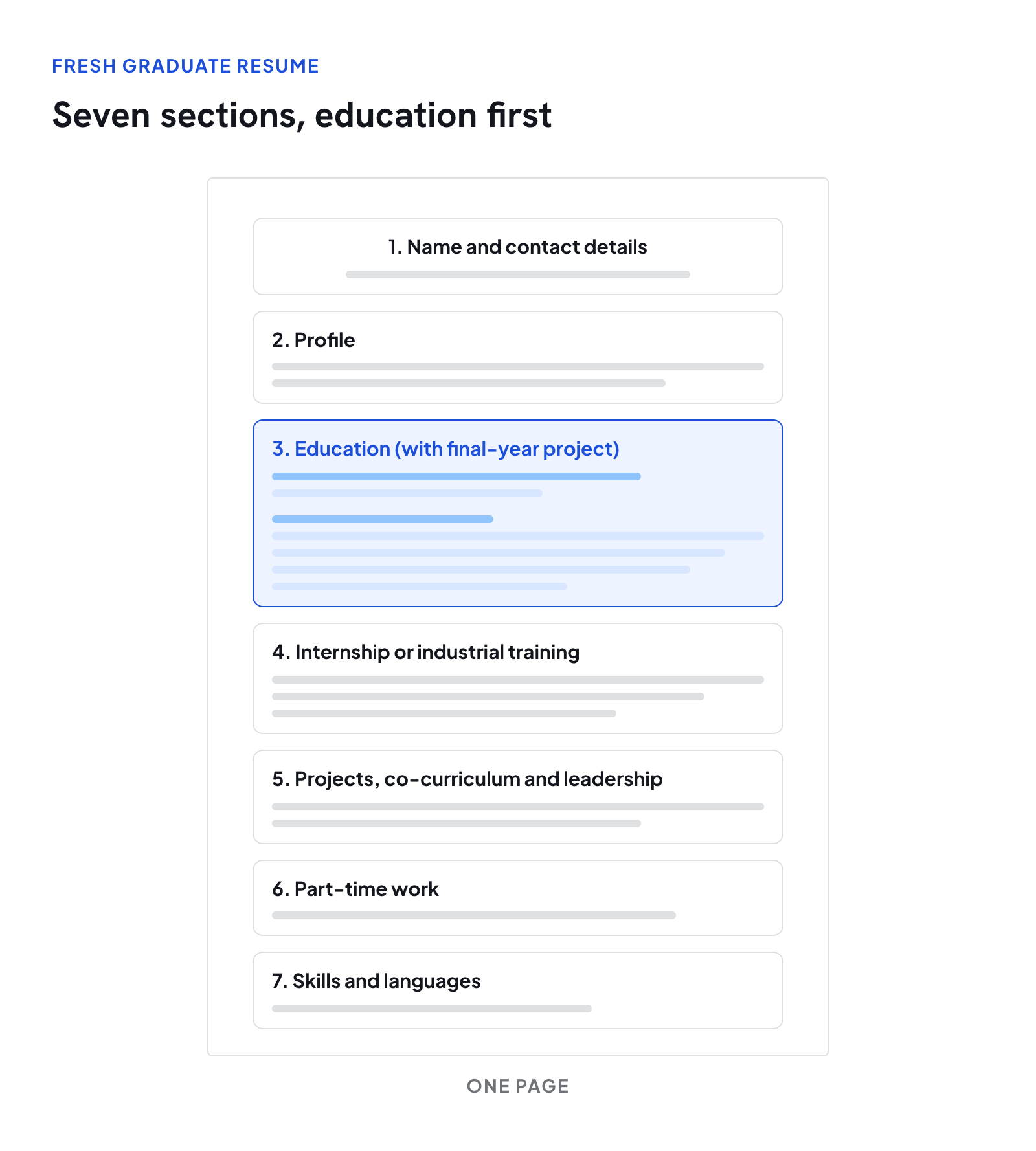
The order that works:
Name and contact details
Profile, two or three lines
Education, including your final-year project
Internship or industrial training
Projects, co-curriculum and leadership
Part-time work
Skills and languages
For what goes in the header and which personal details to leave off (IC number, photo, age, race, religion), see our guide to resume format in Malaysia. The short version is that a fresh graduate's header looks exactly like anyone else's.
Education
Give the degree, the university, the dates and your CGPA if it helps you. A CGPA of 3.00 or above is worth showing. Below that, leave it off and be ready to give it if asked; plenty of employers never do. Add first-class or dean's list honours if you have them.
Drop your SPM results now that you have a degree, unless the ad asks for them. Some government-linked and banking roles ask for SPM or MUET results specifically, and if they do, include them in one line.
Don't list every subject you took. Pick two or three electives that relate to the job, and only if they add something the degree title doesn't already say.
Your final-year project is a work sample
Most graduates bury their FYP in one line under education. Treat it as the closest thing you have to a portfolio. You set a problem, worked on it for months, made decisions, hit problems and delivered something that was assessed.
Write it up the way you'd write up a job:
What the project was, in plain language a non-specialist could follow
What you built, analysed or found
The tools and methods you used, by name
A result, if you have one: an accuracy figure, a grade, a supervisor's assessment, a prize
An accounting graduate whose FYP looked at the impact of new audit reporting standards on listed companies can say which companies, how many years of annual reports went into the review, and what the conclusion was. An engineering graduate can describe the prototype and how it tested. That is far more useful to a Big Four audit firm or a Japanese electronics MNC in Penang than "Final Year Project: completed".
Internship and industrial training
Most Malaysian degree programmes include a stint of industrial training, and it counts as work experience. Give it its own heading, with the company, your title, the dates and three or four bullets.
The trap is writing bullets that describe what the department did. "Assisted in the preparation of monthly management reports" could have been written by anyone who walked past the finance team. Say what you personally did, and what came of it: "Built the Excel template the finance team now uses to consolidate monthly sales from six branches".
If you can't remember a number, estimate one you can defend. "Processed about 200 supplier invoices a week" is fine. Inventing a figure you can't explain in an interview is not.
Co-curriculum and leadership
University clubs, societies, sports teams, volunteer projects and residential college committees all belong here, but only when you can say what you did in them. "Member, Accounting Society" is a line of nothing. "Treasurer, Accounting Society: managed a RM18,000 annual budget and introduced online payment for event tickets" is a line a finance manager will remember.
Two or three solid entries beat a list of eight. Choose the ones with responsibility and an outcome, and the ones closest to the kind of work you're applying for.
Part-time jobs
Weekend shifts at a café, tuition, retail during the school holidays, delivery riding, freelance design for a relative's business: list them. Employers hiring graduates for client-facing roles want to see that you've turned up on time, handled difficult customers and taken money without it going missing.
You don't need many bullets. One or two will do, focused on the part that transfers: handling customers, training new staff, closing the till, managing a schedule around your studies.
Skills, without the filler
List the tools and skills the job ad asks for that you can genuinely use: Excel to the level of pivot tables and XLOOKUP, SQL, Python, SAP, AutoCAD, Canva, Google Analytics. Group them so they're easy to scan.
Leave out soft skills as a list. "Teamwork, communication, problem-solving" appears on every graduate resume in the country and tells a reader nothing. Show those in your bullets instead, where they come with evidence.
Languages are worth stating with honest levels. A KL employer with regional clients wants to know whether you can write in English, speak Bahasa Malaysia comfortably and handle a call in Mandarin, Cantonese or Tamil.
Every job page on Eternity Job lists the skills the employer wants. Read them before you apply, and make sure the ones you really have appear on your resume in the same words.
A worked example
Here is the one-page resume the same graduate sent after the rewrite, for a junior data analyst role at a regional e-commerce company in Bangsar South. Your details will look different, but the structure carries across any field.
YOUR NAME
Graduate, Data Analytics

Puchong, Selangor
011-2345 6789 | yourname@email.com
github.com/yourname

PROFILE
Computer science graduate with internship experience in logistics
analytics. Built a delivery-delay prediction model for my final-year
project. Looking for a junior data analyst role in e-commerce.

EDUCATION
Bachelor of Computer Science (Hons), Data Science
Private university, Cyberjaya | 2022 – 2026 | CGPA 3.41

Final-year project: Predicting late deliveries for last-mile logistics
- Trained a classification model on 14 months of anonymised delivery
  records supplied by my internship company
- Identified rainfall and order cut-off time as the two strongest
  predictors of late delivery
- Graded A; presented to the company's operations team

INDUSTRIAL TRAINING
Data Analyst Intern | Logistics company, Shah Alam | Mar – May 2025
- Built a Power BI dashboard tracking on-time delivery by hub, now
  used in the operations team's weekly meeting
- Cleaned and merged three years of courier data in Python and SQL
- Automated a weekly Excel report, saving the supervisor about three
  hours a week

LEADERSHIP AND ACTIVITIES
Hackathon Lead, Programming Club | 2023 – 2025
- Organised two 24-hour hackathons with 120+ participants each
- Secured RM6,000 in sponsorship from three local tech companies

PART-TIME WORK
Barista | Café, Mid Valley Megamall | Weekends, 2022 – 2024
- Trained four new part-timers on the till and opening checklist

SKILLS
Data: Python (pandas, scikit-learn), SQL, Power BI, Excel
Tools: Git, Jupyter, Google Sheets
Languages: English (fluent), Bahasa Malaysia (fluent),
Mandarin (fluent), Cantonese (conversational)
Notice what isn't there. No photo, no IC number, no SPM results, no hobbies, no "hardworking". The profile is three lines and names the role being sought. Every bullet starts with something the graduate did.
None of the numbers are invented either. The three hours a week came from the supervisor's comment in the internship evaluation, and the sponsorship figure is on the club's records. If an interviewer asks about any line, the graduate can talk for two minutes about it, which is exactly what will happen. When it does, the first question is very likely to be "tell me about yourself", and our guide to that answer builds on the same material.
Before you send it
A few checks that catch most of the mistakes:
Read it on your phone. If it's hard to read there, it's hard to read for the recruiter on the LRT.
Check every date and the spelling of every company name.
Save it as a PDF named with your own name, such as
Your_Name_Resume.pdf.Adjust the profile and the order of your bullets for each type of role. A version for data analyst jobs and a version for software engineering jobs is reasonable. Thirty versions is not.
Ask someone who works in the field to read it for five minutes. A lecturer, an internship supervisor or a senior from your course will spot what you can't.
Then keep applying. Waiting to hear from one company before trying the next is how a two-month search becomes a six-month one. Setting up job alerts that actually match what you want takes ten minutes and saves you searching from scratch every morning.