How to negotiate a job offer in Malaysia, from base pay to start date
Eternity Job Career Team20 October 2026 · 8 min read
A finance analyst in the Klang Valley had two offers on their phone by Thursday night. A regional shared-services centre in Bangsar South offered RM8,000 a month. A listed property group in PJ offered RM7,500. The analyst was ready to take the higher number and go to bed. Then they read the second letter properly, and by the time it was all added up, the "lower" offer was worth about RM5,600 more a year.
Most people negotiate the one figure in bold and sign everything underneath it. You should negotiate the package, and you should do it once, calmly, in writing.
Add up the whole offer before you reply
Put every offer on the same footing: what the employer will pay you, or on your behalf, over twelve months. Here is how the analyst's two letters compared.
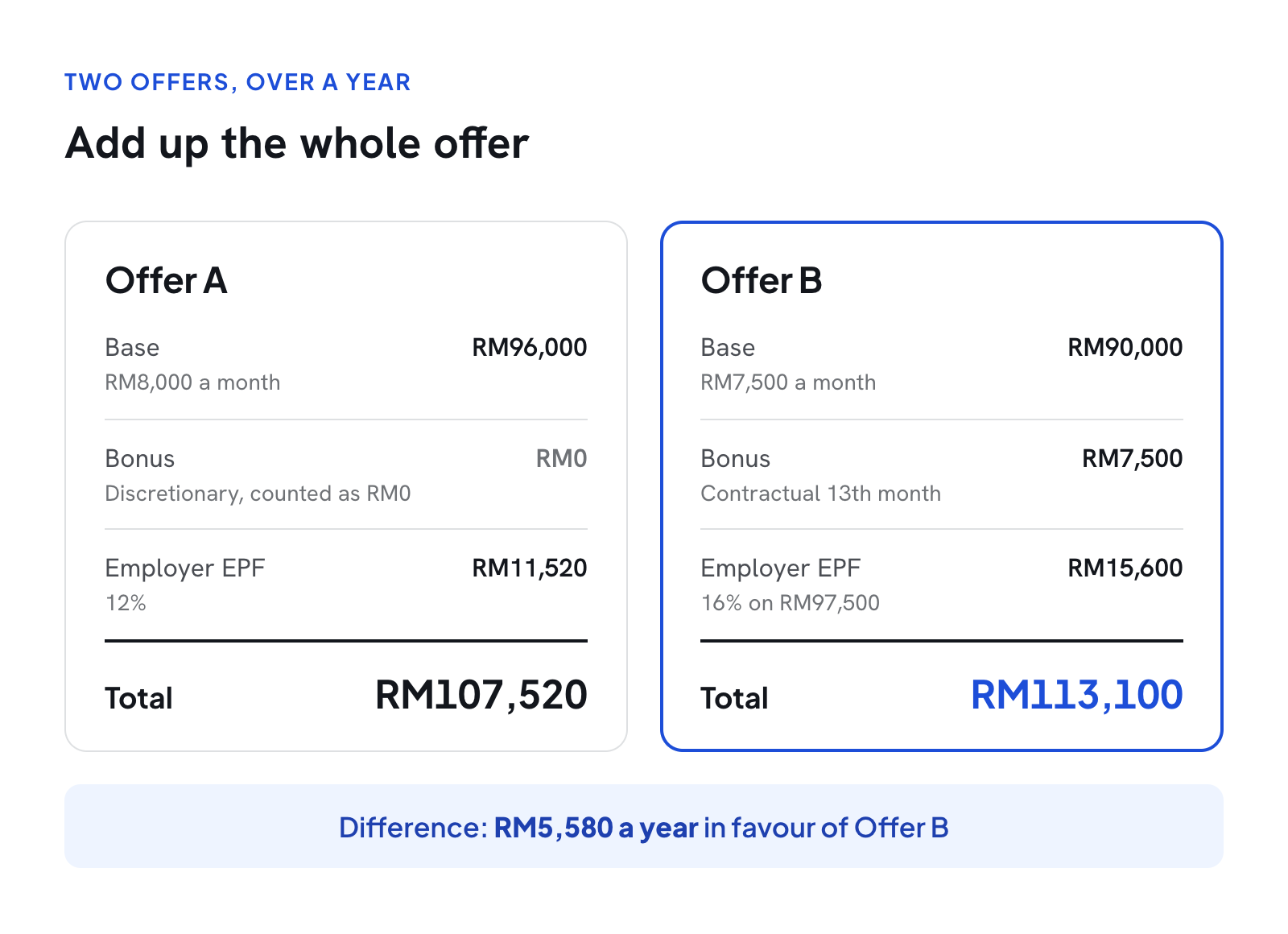
Offer A: RM8,000 base, so RM96,000 a year. Employer EPF at the statutory 12%, which comes to RM11,520. A bonus described as "discretionary, based on company and individual performance". Total you can count on: RM107,520.
Offer B: RM7,500 base, so RM90,000 a year. A 13th-month payment written into the contract, worth RM7,500. Employer EPF at 16% instead of the statutory rate, on RM97,500 of wages, which comes to RM15,600. Total you can count on: RM113,100.
The difference is RM5,580 a year. Count a discretionary bonus as zero until you have seen one paid. You can ask what it has averaged over the past three years, and a good employer will tell you, but it is still a promise and not a term.
On EPF, the statutory employer share for employees under 60 is 13% on monthly wages of RM5,000 and below and 12% above that, against your own 11% (KWSP, as of October 2026). Anything above that is real money in your EPF account, and worth asking for.
There is one catch in those sums. Next year's increment will almost certainly be a percentage of base, and so will any future employer's offer. A 13th month and a richer EPF rate are worth more today, but a higher base compounds. If the two offers are close, take the higher base. If they are RM5,000 apart, take the money. For how increments and bonuses usually work here, see annual bonus and increment.
The parts of a package worth asking about
Most of these cost the employer less than a salary increase, which is exactly why they are easier to win.
Fixed allowances: transport, phone, parking. Ask whether they are fixed monthly amounts or reimbursed claims. Fixed is better; it shows up on your payslip every month.
Bonus: contractual (a 13th month or a guaranteed sum) or discretionary. Ask which, and get the answer in the letter.
EPF above the statutory rate. Some MNCs and GLCs pay it as standard. Ask.
Medical: outpatient limit, hospitalisation cover, whether your spouse and children are included, and whether there is a panel clinic near home or only near the office.
Annual leave. The Employment Act floor is 8 days a year for under two years' service, rising to 12 and then 16 (malaysia.gov.my). Plenty of employers offer 14 or more from day one. Two extra days of leave is an easy concession for a hiring manager to make.
Working arrangement: how many days in the office, and whether that is a policy or a manager's goodwill.
Start date, and whether they will cover any notice you have to buy out.
Title. It costs nothing to change and follows you to every future application.
How to counter
Thank them, confirm you want the job, then name what you want. One email, one list. Do not bargain line by line across a week of phone calls; it wears goodwill down and you end up negotiating against yourself.
Ask for a specific number. "Is there any flexibility?" invites a no. Pick a figure you can justify, and pitch it slightly above the one you would accept so there is room to land.
Hi [Recruiter's name],

Thank you for the offer for the Senior Finance Analyst role. I'm keen
to join, and the team and the scope are what I was hoping for.

Before I accept, I'd like to ask about two points:

1. Base salary of RM8,200. My current base is RM7,100 and this role
   adds regional reporting for three markets, which I handle today.
2. Fourteen days of annual leave rather than twelve.

If those work for you, I can sign this week and start on 1 December.

Best regards,
[Your name]
That email does three things well. It leads with enthusiasm, so nobody reads it as a threat. It justifies the number with the scope of the job, which is the only argument a hiring manager can take to HR. And it offers something back, a fast signature and a firm date.
If they come back and say the base is fixed, move the ask sideways rather than letting it drop.
Understood on the base. Could we look at a fixed transport allowance
of RM400 a month instead, or a salary review at the end of probation
written into the letter? Either would close the gap for me.
A salary review "at confirmation" is a common and useful concession. Make sure the letter says when it happens. A promise to "review" with no date attached is a promise you'll be chasing for a year.
If you were asked for your expected salary earlier in the process and gave a range, the employer will usually offer near the bottom of it. That is normal. You can still counter towards the top with a reason. Our piece on answering the expected-salary question covers how to set that range in the first place.
Most job cards on Eternity Job show the salary range the employer is hiring at. Before you counter, look at what similar roles near you are advertising, and use that as your evidence.
When your current employer counters
You resign, and two days later your manager calls you in with a better number. It happens a lot in the Klang Valley, especially in finance, tech and anywhere a team is already short.
Decline it, almost every time. The reasons you started looking rarely go away with a raise. You have also told your employer you are prepared to leave, and they will plan around that, whether or not anyone says so. Some people accept, stay six months, and leave anyway, having burnt a bridge with the new employer along the way.
There are exceptions. If you were leaving purely over pay and the counter fixes it properly, with a new title and a written letter, it can make sense. Decide before you resign what number would make you stay. If you cannot name one, you are going.
Whatever you decide, decide quickly and say it plainly.
Thank you, I appreciate the offer and the time you've given me
here. I've thought about it carefully and I'm going to go ahead
with my resignation. I'll make sure the handover is complete
before my last day.
If you have not resigned yet, our resignation letter template has a version you can adapt.
Your start date and notice period
Check your current contract's notice clause before you agree a date. One month is common at junior levels, two or three at senior ones. Some employers will release you early. Some will let you pay salary in lieu of notice. If that is the case, ask the new employer to cover it; for senior hires it is an ordinary request.
Do not promise a date you cannot keep. Starting two weeks later than the hiring manager hoped is forgotten by your first month. Starting late after you promised is remembered.
Get it in writing before you resign
Never resign on a verbal offer. Wait for a signed letter or contract. The Employment Act 1955 requires a written contract for any employment longer than a month (section 10), so asking for one is not being difficult.
When it arrives, check that it says:
Your title, reporting line and work location.
Base salary, and each allowance as a fixed monthly amount.
Whether any bonus is contractual, and how much.
Employer EPF rate, if above statutory.
Annual leave, medical leave and medical cover.
Probation length and what happens at confirmation, including any salary review.
Notice period on both sides, during and after probation.
Working arrangement, if you negotiated one.
Start date.
Anything you agreed by email that is missing from the letter, raise before you sign. A short reply is enough: "Thanks, could the letter also reflect the RM400 transport allowance we agreed on 14 October?" Then sign, send it back, and only then hand in your notice.
The analyst sent the email above to the PJ property group. The group came back at RM7,900 and the fourteen days, and the analyst signed the following Tuesday.