How to get your employer to pay for a course through HRD Corp
Eternity Job Career Team20 October 2026 · 8 min read
A data analyst at a logistics company in Shah Alam with about 120 staff wanted a cloud data certification that cost a little over RM3,000, and assumed the fee would come out of their own pocket. The analyst mentioned it to HR almost as an afterthought. The answer was that the company had a training levy balance it was struggling to spend, and could the analyst send them the course details by Friday.
That conversation happens less often than it should. If your employer is registered with HRD Corp, a slice of every month's payroll is already set aside for training, and someone has to ask for it to be used.
What HRD Corp is, and who pays into it
HRD Corp (Pembangunan Sumber Manusia Berhad) runs the national training levy under the PSMB Act 2001. As of October 2026, its registered employers page sets out two tiers:
Employers with 10 or more Malaysian employees must register, and pay a monthly levy of 1% of their employees' monthly wages.
Employers with 5 to 9 Malaysian employees may register voluntarily, and pay 0.5%.
Coverage extends across most private-sector industries listed in the Act's First Schedule. The employer FAQ excludes federal and state government, statutory bodies and certain NGOs, such as unions and religious or political organisations. The levy is counted on Malaysian employees only.
The levy is the employer's cost. HRD Corp's FAQ says employers are not allowed to deduct it from employees' wages under any circumstances. If you see it on your payslip as a deduction, that is wrong, and HR should hear about it. (Our guide to reading your payslip covers what should and should not be there.)
What that adds up to
The wages counted for the levy are basic salary plus fixed allowances. HRD Corp's levy guideline leaves out bonuses, commissions, overtime and similar variable pay.
Take the analyst's employer. If its 120 Malaysian employees average RM4,500 a month in basic pay and fixed allowances, the levy works out like this:
RM4,500 × 120 = RM540,000 in monthly wages
1% of RM540,000 = RM5,400 a month
RM5,400 × 12 = RM64,800 a year
That money sits in the employer's HRD Corp account to fund approved training. It is not a tax that disappears into the government's general budget. And there is pressure to spend it: HRD Corp's Employers' Circular No. 7/2019 cut the period an employer can leave its levy unused from five years to two, with a minimum balance of RM10,000 protected. That rule is the main reason HR departments are often glad when someone walks in with a sensible course.
How a claim works
The process is employer-led. You cannot apply to HRD Corp yourself for a course under your employer's levy. Your HR team submits the grant application through HRD Corp's e-TRiS system, and the course has to be one a provider has registered with HRD Corp.
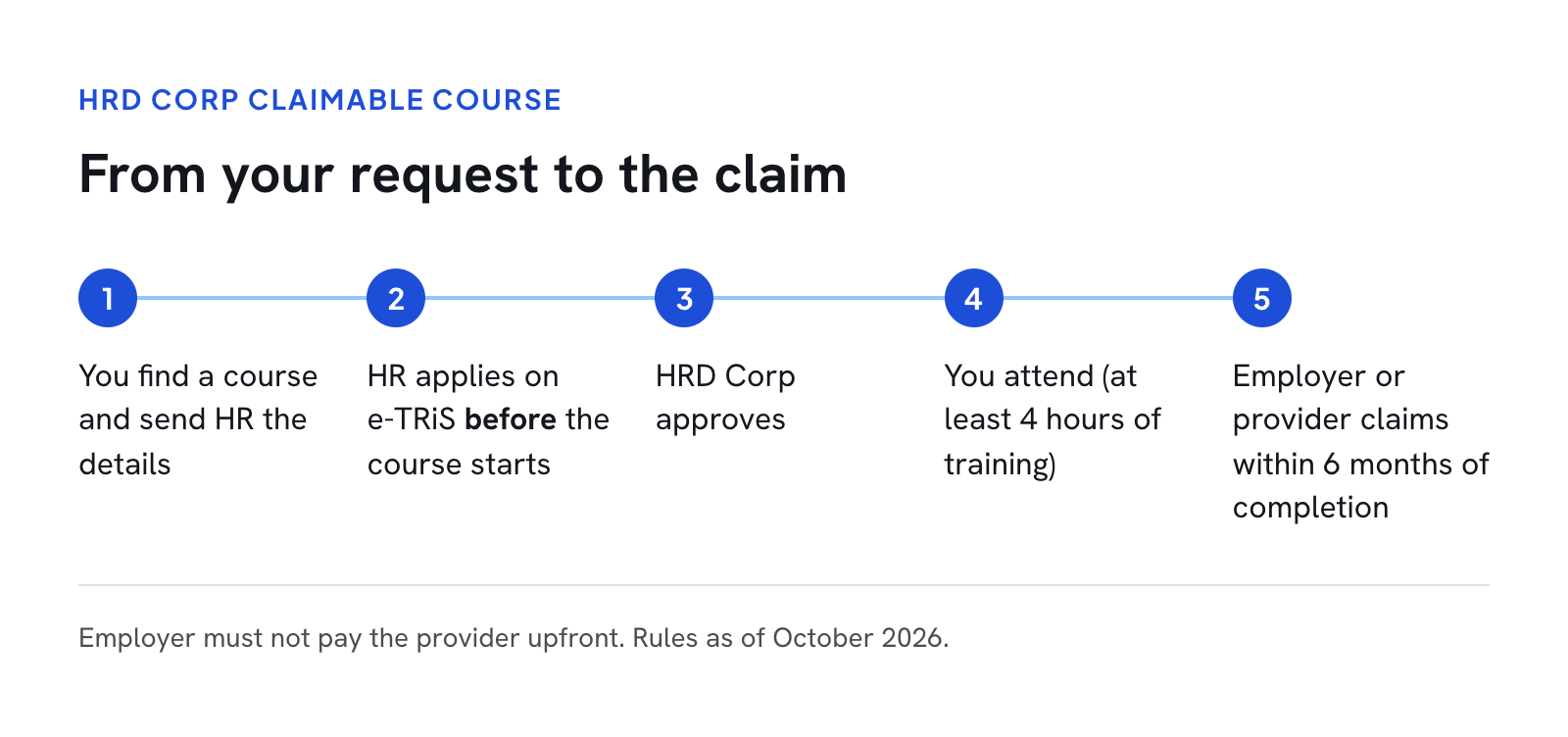
The main scheme for most office staff is the HRD Corp Claimable Course. As of October 2026, HRD Corp's page sets these rules:
The training must be at least four hours, in-house or public.
The employer applies through e-TRiS before the training starts, with a quotation or invoice, the schedule or course content, and the trainer's profile.
In-house training can start 14 days after approval. Public courses can start three days after approval until 31 December 2026, and the 14-day rule applies again from 1 January 2027.
Training must start within 90 days after that waiting period ends.
The claim goes in within six months of the course finishing.
The employer must not pay the training fees to the provider upfront.
Beyond the course fee, the scheme can cover meal and daily allowances, materials, venue, and travel within HRD Corp's Allowable Cost Matrix, which caps what each item can be claimed at.
Two practical consequences follow. First, timing. A course that starts next Monday is almost certainly too late for this cycle. Give HR at least three weeks, more for in-house training. Second, the provider matters. A course that is not registered with HRD Corp cannot be claimed, however good it is.
How to ask for it
Do the work for HR before you ask. A manager will say yes to a request that is already half-processed far more often than to "can the company send me for some training?"
Before you go to your manager, find out three things from the provider:
Whether the course is registered as an HRD Corp Claimable Course, and its programme reference.
The fee, the dates and the total training hours.
Whether they can issue the quotation in your employer's name.
Then tie it to your work. Your manager needs to be able to explain the course to their own boss in one sentence. "Our analyst is building our dashboards on spreadsheets; this certification moves them to the cloud warehouse we already pay for" will get approved. "Our analyst would like some personal development" will sit in an inbox.
Hi [Manager's name],

I'd like to take the [course name] run by [provider] on [dates]
([X] hours). It covers [two or three specific skills], which I'd use
on [specific project or task].

The provider confirms it is registered as an HRD Corp Claimable
Course (programme ref: [number]). The fee is RM[amount], and they
can issue the quotation to the company.

Public courses need HRD Corp approval at least 3 days before the
start date, so HR would need to submit by [date]. I'm happy to send
HR the documents directly if you're OK with this.

Thanks,
[Your name]
Raise it at your appraisal if you can. Training is one of the easiest things for a manager to agree to in a review, because it costs their department's budget nothing. If your increment is disappointing, a funded certification is a reasonable thing to ask for alongside it. Our piece on bonus and increment season has more on what to ask for.
A note on bonds
Some employers ask you to sign a training bond for expensive courses: if you leave within a set period, you repay some or all of the cost. Read it before you sign. Check the amount, how long it lasts, and whether it reduces month by month. A bond on a RM3,000 course that runs for three years is out of proportion, and you can say so.
Finding courses worth taking
HRD Corp's site has a programmes section, but the quickest route usually runs the other way round. Pick the qualification you want first, then ask the provider whether that course is registered as HRD Corp-claimable and for its programme reference. Providers that run claimable courses tend to say so on the course page, because it is how they sell to HR departments.
Look for courses with a recognised exam or certificate at the end. A one-day "leadership masterclass" in a hotel ballroom may be pleasant, but a credential you can list on your CV is worth more when you next apply.
Set an Eternity Job alert for the role you are training towards. The skills listed in those ads are a good check that the course you picked is one employers actually want.
If your employer is not registered, or you are between jobs
The levy only helps if your employer is covered. If you work for a small firm with fewer than ten Malaysian employees, or for a government body, there is no levy balance to draw on. A few routes are worth knowing.
HRD Corp's individuals page lists programmes aimed at people rather than employers. The HRD Corp Placement Centre is a portal for job matching, training and career counselling. The Recognition of Prior Experiential Learning (RPEL) scheme certifies existing skills for workers with secondary education or lower.
If you pay for a course yourself, check the tax relief. LHDN's tax relief list allows up to RM2,000 for upskilling or self-enhancement courses, within the RM7,000 education fees relief, where the course is recognised by the Director General of Skills Development. LHDN's 2026 explanatory notes say this relief runs until the 2026 year of assessment.
The analyst's certification was approved in eleven days. The exam was passed in February, and the certificate went to the top of the analyst's CV the same week.